#1: Kosei’s My Hero Takeshi Aiza
# 1  Kosei’s My Hero
  Takeshi Aiza
It’s June. I’m in the outskirts of the western part of Tokyo, in a township that’s too big to be called a ward but just barely a city. It’s a residential area with lots of greenery, where the houses have tiny gardens with lawns, and everyone’s got a luxury car sitting in the garage.
I’m inside one of those houses right now.
“Takeshi, you going to do this or what?”
That’s my teacher, Akira Takayanagi. He sounds exasperated, like he’s about given up. Then he plops down into the sofa behind the piano, folding his hands behind his head, and gives a loud sigh.
“What, think you can just take it easy, like you’ll get away with phoning it in at practice?”
Damn…guess I’m busted, I mutter in my head as I sit facing the piano.
Cut me a break, man. After school, we went head-to-head against Class One—I’m in Class Two, the next room over, and we’re all in fourth grade—in a soccer game, where our pride was on the line. Okay, well, they’d egged us on to play them, and since I’m the fastest runner in my class, the team would’ve lost without me, you know?
I had to spend two hours after school every day this week practicing for the game. I was wiped, and on my best day I could play piano for two hours. I was basically good for about one hour, and besides, it’s no fun playing basic etudes where you just practice your finger movements. Well, for set pieces I guess I’d do it.
“Do you even really want to catch up with Kosei Arima, and become better than him?”
“…Yeah.”
Kosei’s my hero. He’s awesome. He’s got the strength to never lose.
He plays his set-piece music perfectly. His performances are flawlessly accurate, and he has the guts not to choke under pressure.
“If so, there’s only one answer. There’s too big a gap between how much you practice. Once you put in as much practice as he does, go ahead and talk a big game about catching up to him, and whatnot.”
“How much time are we talking?” I ask, pouting my lips as I turn back to look at Mr. Takayanagi.
I practice every day. If I take even one day off, my fingers don’t move right for three days.
“Every morning, I suppose he plays for an hour before going to school, and after class he must do another four hours or so. At least one of those hours he’s got to be working on his basic etudes. After that, he’ll drill the piece into his head. He’ll break it up and take it two measures at a time, until they’re perfect. When he’s done that for all four pairs, he’ll go all the way through from one to eight until it’s all perfect. Then he’ll repeat that…well, probably.”
“No way! That’s sooooo boring, practicing that much. I like to practice the whole thing start to finish.”
“If you do that, you trick yourself into thinking you can play it, and you end up missing the little details. Wasn’t it your goal to play perfectly like a machine, with no mistakes or weak spots, and consistently?”
“Well, yeah…but I don’t want to practice something so boring.”
Mr. Takayanagi stands up and leans down close to my face with a serious look. “If you want to be great, you have to believe in yourself.”
Nighttime.
My folks live in a new housing area, not as green or stylish as Mr. Takayanagi’s neighborhood. It takes as long as fifteen minutes to get to by bus from the private rail station, plus our place is in an alley off the main street.
When I get home from Mr. Takayanagi’s piano lesson, the first thing I do is rush to my room and take out the program from the district preliminary round of the piano competition the other day. I barely made it. Guess who blew way past everyone in the prelim? Kosei Arima, a fourth grader just like me.
Since it was the whole elementary school section, there were fifth and sixth graders competing too, but out of everybody he took the prized top spot. This was my fourth time to play in the same contest as Kosei. He’s come in first every time.
The first time I met Kosei was at the same district prelim, exactly a year ago. It was my first competition.
I didn’t really want to be a professional pianist, I just thought I’d give it a try.
About two months before that, I’d just begun third grade. One day, it was my group’s turn to clean the music room, when I found a music score still sitting on the closed lid of the grand piano. It was Mozart’s “Turkish March,” which the music teacher had played in class that day. I flipped through the sheets, and it looked like I could play it, so I did.
My classmates were so impressed…heck, so was the music teacher. I felt great so I played it for Mr. Takayanagi, too. After playing it once I remembered pretty much the whole thing.
“The ‘Turkish March’…that’s Mozart’s Piano Sonata No. 11, 3rd movement. You almost know it by heart after playing just once…and already at such a fast tempo?”
From the pile of papers and music books on the table next to the sofa, Mr. Takayanagi picked out a music book that had a brand-new tag and no bent corners. He opened it to the page with the tag on it and gave it to me.
“Can you play this one?”
“Yeah. You mean like this?”
I made a few mistakes, but it came together somehow on my first try.
“I knew it…Takeshi, I’ve taught you for almost four years now, and I’ve often been surprised by how fast you’ve improved and how good your intuition is. But you’re moody and hate practicing and can’t apply yourself unless I dangle a carrot in front of you.”
Mr. Takayanagi thought to himself for a while.
“All right, then,” he muttered at last. “If I promised to buy you a Hero Transformation Belt of your choosing, would you try playing this piece in a competition?”
“A competition? I’d have to practice a lot, right? No thanks.”
He got closer to me, full of excitement.
“That’s why I’m saying I’ll buy the belt. It’s precisely the piece I singled out for the piano competition that’s being sponsored by the company Neo Musika. Don’t you wanna know how much better you can play than the other kids? It’s like how everyone knows you’re the fastest in your class when you run a sprint race—it’s the same with the piano. It’s obvious who’s got the goods and the talent.”
That’s how I ended up participating in my first competition a year ago, which is when I met my super-awesome hero.
My hero…Kosei Arima, the one who got called a child prodigy playing one of Mozart’s Piano Concertos with an orchestra last month.
In competitions, people usually play from memory, but most of the time they forget little details because they’re nervous. The scores have too many directions. It’s not just which key you have to tap, it’s also the length of the key, how loud or how soft, the tempo, how your fingers move, the Italian words telling you all sorts of vague sensations, like to make it sound like singing, or to play more intensely or relaxed, whether you step on the pedal or not, and…you get the idea.
Especially if you mess up your fingering and play with a different finger than you’re supposed to like a klutz, you’ll end up touching the wrong key because your finger can’t reach the key for the next note, and the length of your notes will end up sounding weird or you’ll put in an extra sixteenth rest that’s not on the sheet.
Those directions are put there by the composers, but they’re for adult players. These are competitions for elementary school kids playing with tiny hands, so of course the performances can’t be perfect. The mistouches, noises, and strange silences coming from our fingers not being able to reach mean that we stumble through our performances.
It’s not easy for the listeners to get through, either.
But Kosei was different. First, the song he picked was a little tough, and cool too.
It was Beethoven’s Piano Sonata No. 17 in D minor, Op. 31/2, 3rd movement—people usually call it “The Tempest.” That means a storm. I knew the song.
Kosei played it exactly like a professional pianist you’d hear on a CD, just the way it’s written in the sheet music with no mistakes. It was an impressive performance, worthy of a song with an awesome title like “The Tempest.”
Whoa…just whoa.
I’d already had my turn near the start of the competition and was in the audience listening to him play. I didn’t really care that my ranking wouldn’t be so great, and my teacher had said it’d be good for me to hear the other kids’ performances. He said I’d see for sure that they all practiced harder than me.
Not that there’d been someone that amazing or anything.
Nobody here’s that different from me. Maybe I’ll even end up with a way higher score than I thought? I mean, I didn’t make any huge mistakes—nothing worse than being a little fast with my tempo.
I’d even started to get bored, but then came the shock.
Whoa! Where’d he come from? He’s too good! His playing’s matching the score perfectly.
It wasn’t just me who thought it was freaky. Almost all the contestants and most of the audience did too.
Well, Kosei’s fans and the judges looked like they knew what to expect, but everyone else.
When he finished playing, he got up and bowed to the audience.
The place went totally quiet for a moment. That hadn’t happened for any of the other kids.
Then a second later, the crowd broke out into applause. There was a big commotion and people were so impressed they were sighing, and from every direction around me, I could hear people whispering.
“Look at that—any kid who plays with the pros is something else.”
“I thought that stuff about playing with a real orchestra was just a way of getting attention, but with talent like this he can be a professional!”
But Kosei didn’t look happy at all. He wasn’t blushing, and he wasn’t giving a polite smile, either. He didn’t even try to act all big. Without moving a single hair of his eyebrows, which were lined up with the frame of his nerdy glasses, he hurried off the stage.
He’s like some cool gunman from a Western. Like he just had a life-or-death duel with a bad guy and is leaving now with an everyday look on his face. A super-alloy robot with a heart of steel and skills nobody can rival. So strong, so cool!
He was a hero.
Kosei was my hero.
I wanted to be crazy good like that, too. I wanted to be invincible. I wanted to be able to play my sheet music perfectly, with no mistakes, doing exactly what it says on the pages.
Ever since then, Kosei Arima’s been my goal.
I check the listings in the program to remind myself of the name of the elementary school Kosei goes to. It’s a public school, Hibari Elementary.
It never mattered to me before, but his school is actually in the city bordering mine. And on top of that, his neighborhood is next to mine.
Oh, that’s not very far. Wonder if I can bike there?
—If you want to be great, you have to believe in yourself.
“O-kay! Tomorrow I’m gonna find out what Kosei’s practice routine is like.”


The next day, my classes finish before lunch because we happened to have one of our occasional school events. After lunch and our cleaning chores, I head home.
I ride my bike over to Hibari Elementary where Kosei goes. I know how to get there—first I go straight along a bus route that runs through the residential area near my home, then go over the private railroad, then go a little further through the busy area in front of the station, and finally trace another bus route.
I can see the school right in front of me. I park my bike at a small playground in an apartment complex, tie it to a car stop pole with my wire to lock it, and go toward the school gate.
The street in front of the school gate is lined with rows of zelkova trees. Stealthily, I peer past the gate from behind a big zelkova. Seems like I made it there just before school let out. I spot Kosei in the huge crowd of kids. He’s the skinny, bigheaded boy wearing the nerdy black-rimmed glasses. He plods along by himself, his eyes cast down.
Yeah! Found him.
I follow him quietly. On the way, a girl with short hair passes me by and it looks like she invites him to hang out, but he turns her down and goes straight home.
“So, this is the place…”
He says “I’m home” as he goes inside a stylish two-story house. It’s got a tiny little garden but is almost touching the house next door, which is pretty common in residential areas. Seriously, they’re packed so close.
Since my sister started playing piano a year after I did, my parents had the walls in the piano room soundproofed so we wouldn’t bother the neighbors.
Kosei’s house is probably the same way. I sit next to the entrance and wait, but I don’t hear a piano.
Damn, is he really practicing?
That’s when I notice that a middle-aged woman who’s walking her dog is standing there and looking at me.
Yikes!
I walk over one block and come back, so she doesn’t get the wrong idea. Then I squeeze my body into the gap—where there’s some low fencing on each side—between Kosei’s house and the neighbor’s. “Sawabe,” the nameplate on the place next door says.
It’s so narrow that a kid’s body barely fits through.
Now I can just make out the sound of a piano, which I couldn’t from the front of the house. The music room’s probably on the other side of the wall. What I hear coming through is a simple melody…do-la-sol-la-fa-la-mi-la, re-ti-la-ti-sol-ti-fa-ti…
It’s a basic exercise…Hanon No. 6.
Hanon’s a thick piano textbook we use for finger exercises, moving our fingers and building up the muscles in our pinkies and ring fingers, which are usually weak. None of the practice songs in there have any melody or anything, it’s just got sixty boring songs with different patterns.
For example, the very first song, Exercise No. 1, has this string of simple notes—do-mi-fa-sol-la-sol-fa-mi—that make up the first measure. After every measure, you skip a key going up for each note, and you do this for two octaves. Then the pattern changes to sol-mi-re-do-ti-do-re-mi, and you skip a key going back down for each note. Repeat this twice, and that’s the song. For Exercise No. 2, it’s do-mi-la-sol-fa-sol-fa-mi.
It’s kind of like vocal practice in a chorus club, where everyone sings “doo-mii-sool-mii-doo” in higher and higher scales. As a rule, your right and left hands make the exact same movements, but they’re placed in different positions one octave apart.
And that goes on and on in groups of sixteenth notes.
There’s really nothing interesting about it at all.
First you play No. 1 and No. 2 four times, going back and forth and playing them with different rhythms. Next you continue with No. 3, No. 4, and No. 5, cycling through them four times, and then you play a set of No. 6, No. 7, and No. 8 four times. Even just the first section has twenty songs and seven sets.
Kosei plays it like a master, tapping the keyboard as fast as seven times a second. That’s the fastest of all the speeds listed in the sheet music. He’s scary fast. And with perfect accuracy, without skipping over any notes, and without losing speed, he keeps on tapping his keys.
Creepy…how’s he able to keep playing without stumbling or skipping any notes or anything? His concentration’s awesome.
With this kind of simple practice stuff, usually what happens is you lose your concentration at some point, or something else pops into your head, and you end up skipping the note you’re supposed to play, and the second you skip over a key and slip up, you forget what you were just playing.
Kosei’s the man. There’s no way I can do that.
And yet…assuming he’s playing in order from No. 1, he’s played for about an hour without making any mistakes. He’s so great, and his notes sound so beautiful and in harmony. But at the same time, I’m kinda getting tired just listening to him—it’s like, okay, enough already, I get the idea.
Well, I’m gonna be stubborn. I’ll keep listening until he gets to the set piece. Don’t wanna waste a chance like this.
I glance at my wristwatch.
Man, it’s hot…Right, the rainy season’s already here. It’s even worse when the sun’s out. Ugh, it’s so hot, and so humid. I can feel the sweat oozing out of my pores on my back. The soundproofed room must have an air conditioner keeping it nice and cool.
Ti-do-mi-re-do-re-mi-do…That means he’s started playing the set from No. 12 to No. 14…Come on, man, isn’t it time to stop? Are you really gonna play through all the way to No. 20?
I wait, counting off the songs that are left to play. The sound keeps going on, like a machine is playing, and doesn’t even stay in my head anymore—it’s just in one ear and out the other.
I can wait just because I know how many songs are left, but otherwise this would be totally unbearable…Hang on, there’s no way he’s gonna play all sixty…the scale from No. 32, three and then six chords from No. 48, the octave played with one hand…
Unbelievable, the day would come to an end just doing the finger practice.
I really get how intense Kosei’s practice is, so I decide that if he starts playing No. 21 I’m just gonna leave.
Thank god, he gets to No. 20 and the Hanon’s finally done. Now, he starts playing a real song. The Well-Tempered Clavier No. 1: Prelude and Fugue in C major, by Bach…one of the set pieces for the next competition.
The early part, called the Prelude, is known as an accompaniment to Gounod’s “Ave Maria.”
When it comes to set pieces for advanced players in piano competitions, most of the time you have to pick from one or two out of the four big genres: there’s Baroque, where Bach is usually the go-to choice; Classical, like Haydn, Beethoven, and Mozart; Romantic, where Chopin’s a big favorite but once in a while you get maybe Liszt or Brahms; and Modern, which is everything that comes after those.
Nevertheless, it’s rare for Modern songs to be chosen. Mostly it’s Bach, Beethoven, Mozart, or Chopin, composers whose faded old portraits are hanging on the wall of the music room in any elementary school. You know, like the portraits whose eyes move late at night in those creepy stories or the Seven Classroom Wonders.
Anyway, Kosei starts playing the “Ave Maria piano accompaniment,” which many people would probably say they’ve heard before…but only somebody like me can tell that it’s “Ave Maria.”
Because he plays just the very first measure of the Prelude—da-da da-da-da da-da-da, da-da da-da-da da-da-da, a phrase made up of eight sounds, twice, and that’s it. Then he goes back and starts all over again. Da-da da-da-da da-da-da, da-da da-da-da da-da-da.
Or as we say in musical notes, do-mi sol-do-mi sol-do-mi, do-mi sol-do-mi sol-do-mi, in C major.
He plays it accurately, with the same length, the same strength, and every sound the same in quality. Da-da da-da-da da-da-da, da-da da-da-da da-da-da. Then again. Da-da da-da-da da-da-da, da-da da-da-da da-da-da.
Seriously? How many times do you play the first measure? It’s beautiful…everything is perfect, exactly the same tempo and strength as the sheet says. His finger form is just right—it’s not like his right middle finger is too strong, or anything. Tap and release, with all his fingers obeying. No matter how many times he plays, they’re all accurate.
Da-da da-da-da da-da-da, da-da da-da-da da-da-da. Da-da da-da-da da-da-da, da-da da-da-da da-da-da.
I’m so lost in the sound I forget to count…but he plays it ten times, maybe.
Finally, he moves on to the second measure, da-da da-da-da da-da-da, da-da da-da-da da-da-da. That’s do-re la-re-fa la-re-fa, do-re la-re-fa la-re-fa. This time, I try to count. Yep, ten times.
So he plays ten times for the second measure, too. Then he plays the two measures all at once, da-da da-da-da da-da-da, da-da da-da-da da-da-da, da-da da-da-da da-da-da, da-da da-da-da da-da-da.
And next is the third measure. Da-da da-da-da da-da-da, da-da da-da-da da-da-da. That’s ti-re sol-re-fa, sol-re-fa, ti-re sol-re-fa sol-re-fa. Da-da da-da-da da-da-da, da-da da-da-da da-da-da. Da-da da-da-da da-da-da, da-da da-da-da da-da-da. Da-da da-da-da da-da-da, da-da da-da-da da-da-da.
Sometimes the sound doesn’t come out perfectly…I think. Those times he repeats more than usual…right? His rule is he goes on to the next one after playing perfectly ten times—maybe?
I’m so excited. I’ve never heard the sound repeated so accurately.
Awesome, super awesome. He is Kosei, after all.
Then come the fifth and sixth measures, da-da da-da-da da-da-da, da-da da-da-da da-da-da, da-da da-da-da da-da-da, da-da da-da-da da-da-da.
Then the seventh and eighth measures, da-da da-da-da da-da-da, da-da da-da-da da-da-da, da-da da-da-da da-da-da, da-da da-da-da da-da-da.
I’m just like, Wow.
These are very simple, with no chords. So they’d sound really boring if they’re played poorly.
His piano plays so beautifully. Each sound twinkles. Each sound is alive, and feels so here and real.
He’s keeping the same rhythm, so it’s not like each one twinkles a different way. But there isn’t even one sound that’s missing or unclear or bumpy. The notes all shine the same way one after another, every grain of sound comes to life flawlessly. Like pearls rolling out one by one.
Da-da da-da-da da-da-da, da-da da-da-da da-da-da. Da-da da-da-da da-da-da, da-da da-da-da da-da-da.
This was originally composed as a practice song, too. It’s simple, but I feel like I want to hear all the way to the end if I can, unlike those finger exercises before.
As I listen to the music repeating, I start getting this nice, warm feeling. The melody’s so beautiful. Bach’s such a great composer.
Da-da da-da-da da-da-da, da-da da-da-da da-da-da. Da-da da-da-da da-da-da, da-da da-da-da da-da-da. Da-da da-da-da da-da-da, da-da da-da-da da-da-da. Da-da da-da-da da-da-da, da-da da-da-da da-da-da.
Ah, I’m gonna start falling asleep. No, not ’cause I’m bored—it’s just so pleasant that I’m drifting off…and now I’m not. He stumbles and I’m awake again.
He plays it another ten times—da-da da-da-da da-da-da, da-da da-da-da da-da-da—starting over from one phrase earlier.
With all that repeating he did, how long did it take him to play all thirty-five measures of the song?
No way, I can’t hold it in anymore, I need to pee!
Damn. Even though part of me wants to stay, I decide to run off.


You know what I realized? What Mr. Takayanagi said is right, period.
I never knew how comforting music can be. That’s what I gained.
Here inside a convenience store bathroom, I mutter it over and over. “He was right.”
I buy a sports drink with the 150 yen that I’ve got tucked away in the back pocket of my cargo pants, and gulp the whole thing down in the parking lot. Then I head back to the kids’ playground and hop on my bike.
My head is swirling round and round with the thought that he was right, and the piano notes that Kosei kept tapping—da-da da-da-da da-da-da, da-da da-da-da da-da-da, da-da da-da-da da-da-da, da-da da-da-da da-da-da. Even as I start pedaling and head home, the whole time these thoughts stay with me.
Those lovely sounds keep on ringing inside my brain.
Da-da da-da-da da-da-da, da-da da-da-da da-da-da. Da-da da-da-da da-da-da, da-da da-da-da da-da-da.
Those sounds, so perfectly the same, never going away. They keep coming to life, one after another.
Da-da da-da-da da-da-da, da-da da-da-da da-da-da. Da-da da-da-da da-da-da, da-da da-da-da da-da-da.
Does he repeat that kind of practice every day? Day after day, hour after hour, until the sheet music soaks deep down into his core, until he can recreate everything perfectly just like the sheet says?
Making it back to where the streets are familiar, I stop my bike and stare at the palms of my hands.
“It hasn’t…soaked in, has it? It feels like the notes are just floating over my palms…”
I rub my hands against my chest and grab my T-shirt.
“The notes will never be part of me. Not at this rate.”
I pedal my bike really fast.
I rush into my house. “Homework done?” my mom asks me from the kitchen, but I ignore her. I wash my hands in a hurry and then open the lid of my piano. It’s a real grand piano, a recent step up from the old upright we used to have.
I rummage through the colored storage box next to the piano and pull out the same score that Kosei was playing.
I set the score in place and take a seat, get both hands ready over the white keys, and take a deep breath.
I tap them softly.
Da-da, da-da-da da-da-da, da-da, da-da-da, da-da-da. Da-da, da, da-da, da-da-da, da-da, da-da-dadda-da-da. Do-mi, sol-do-mi, sol, do-mi, do-mi, sol-do, mi, sol-do-mi. Do-re, la-re-fa-la, re-fa, do-re, la-re-fa-la-re-fa. Da-da, da-da-da-da-da-da, da-dadda-da-da, da-da-da. Da-da, da-da-da, da-da-da, da, da, da-da-dadda-da-da.
“Ack, I’m getting stuck. My pinkies are weak. No, this is all wrong. Damn, Kosei’s really good.”
He’s my hero, for sure. Nobody can beat him. He’s too awesome.
Wonder if I can ever be like that?
“Hey, Teach, you think I can be unbeatable, too? If I really do it right.”
I ask Mr. Takayanagi this at my next lesson as soon as I sit down in front of the piano. Mr. Takayanagi’s eyes open wide.
“Really do it right, huh? My, my. What’s gotten into you?”
“There’s no other way to be the best, is there—besides sitting at the piano for hours and hours, and playing the same notes so many times you lose count? That’s gotta be what doing it right means, yeah?”
“Yep. That’s the surest way, I’d say.”
“Uh huh…”
I open up the Hanon textbook. First up are the finger exercises…just like how with sports, you start off practice by warming up.
“It’s 25 and 26 today, right?” I ask.
“Now this is strange, Takeshi. For you to be so self-motivated, I mean. What’s up?”
Well, yeah. If I were my usual self, those do-re-mi-do-re-mi-fa-re-mi-fa-sol-fa-mi-sol-fa-mi finger exercises definitely wouldn’t be something I’d care all that much for.
But the thought of telling Mr. Takayanagi that he was right kinda bugs me, so I keep quiet and start carefully playing the practice songs that I used to find so boring.
The entire time, I read the sheet music more carefully, more closely than usual.
“That’s good. It’s like I’ve been saying, these basic exercises help your fingers get stronger and move around faster, which is why it’s so important to do them properly. It’s the same as running and stretching for athletes.”
“…Mm-hmm, I got it.”
Mr. Takayanagi looks surprised to see me so committed and earnest. In his eyes, I never took things this seriously before. Man, that’s rough.
Since then, I’m trying to take my practice more seriously. The reason is, I realized that I’m not even close to Kosei’s level when it comes to making my sounds smooth and even.
I want to be able to make them the exact same quality, like Kosei does. Imagine it like a fighting game—you chain the same basic attack, hit away at your enemies’ weak spots, and clear out the regular mobs.
It’s like laying down a wicked barrage.
If the strength of your attacks is all over the place, they’re hit or miss, and you’re just mashing the buttons, and once your own HP gets low and an enemy slips through, you’re toast.
That won’t cut it—you’ve gotta lay down a perfect barrage. A barrage of notes.
Now I can picture how to become unbeatable.
Every day, I imitate Kosei by playing the Hanon practice songs for an hour, following Mr. Takayanagi’s advice and trying to play two measures at a time perfectly.
After I get home from school, I play for two hours before and after dinner, practicing four hours a day. And on the weekends, I spend the hours that I would be in school practicing, too, so that makes ten hours a day at least.
No more soccer games, dumb conversations, or messing around with my friends, no more video games or TV, no more watching clips online or comic books—I cut all of that out.
All of it, everything. I try my hardest to do without it.
It’s tough turning down my friends’ invitations to play soccer.
And it’s tough saying no when they ask me to play video games, too.
Even when it comes to chatting at recess, just so I can focus on reading my sheet music, I slip out of the classroom and head down the stairs by myself. Leaving the classroom while I can hear everybody’s voices behind me makes me feel so lonely that my chest aches, and it’s really, really tough.
And even though I do all of these things…
At the next concert, I end up losing to Kosei again.
Still, I come in right behind him, finishing second place in the first round. So Mr. Takayanagi is proud of me. ’Cause my track record up to now has always been that I barely make it into the group of ten kids who pass the prelim, and then sometimes I clear the second round, sometimes not.
I’m standing in the hall foyer—in a corner of the big open area in front of the entrance to the audience seats—and looking up at the list of kids who passed the first round that’s been posted to the bulletin board. That’s when I feel Mr. Takayanagi put his hand on my shoulder.
“Takeshi, you worked really hard for this. See? I told you practice would pay off.”
He’s in a really good mood, but for some reason I don’t feel so great. It’s so frustrating…the feeling that I shoulda done better is boiling inside me.
“Mmm…Still got a ways to go, I guess.”
“Terrific, Takeshi, finally you’ve got the ambition to be better. All right, what would you like as a reward if you make it through the second round?”
“…I’ll think about it.”
I shake his hand off me and turn my back to the list.
What I want now isn’t a new Transformation Belt, or the new game console that’s coming out next month, or even the kind of sports bike all my friends from school have started riding.
Before, there was always something I wanted to own.
Man, Kosei really played awesome…
His performance, filling the music hall for the competition, was totally different from the other contestants. What I mean is, even though I knew this ever since I heard his piano for the first time, to me, the smoothness of all his melodies and flawless consistency just seemed different.
Now, I can tell that every little sound that Kosei’s ten fingers make stands apart from other people’s, and his overall songs, the combination of those sounds, also aren’t the same as other people’s.
Every twinkling grain of sound that he plays, every last powerful little pellet of it—that’s what I want.
But I already know that’s not the kind of thing you can just beg someone to buy for you.
I pass through the automatic doors of the music hall, and as I wait for my dad to come pick me up at the drop-off area, I look at the palms of my hands again. I wiggle my ten fingers.
“To get the sound I want, I’ve gotta grab it with these hands, these ten fingers right here.”
It’ll be tough. But it’s the only way.
With my eyes on the second round, I’m at my piano at least five hours every day—since I have homework to do after I get home from school, I force myself to get up early for an extra hour of morning practice. I play the same phrases over and over, shooting for total perfection, until they sound exactly like what’s written on the score.
When I have a little free time, I spend it reading sheet music. I’m constantly walking around with copies of my music sheets and reading. Not just at home, but during school recess, too.
Memorizing a score isn’t something I do while I’m playing the piano. First I read it, and as I’m playing the song in my head or playing air piano, I memorize all the notes and instructions written on the sheet. To help me remember, I also write things down or put highlights on the sheet. Recreating them on an actual piano is what I do in practice.
That’s why once I’ve memorized the score, the sounds of a piano always echo perfectly inside my head, just like what’s on the sheet.
That’s what I play. With my ten fingers, my notes overlap with the perfect piano that’s playing in my brain. I play making sure there’s not even the smallest gap between the two pianos.
Over and over, day after day, I practice.
Now I’m perfect, I think. I have confidence.
Mr. Takayanagi, too, says, “Amazing, Takeshi, if you can produce this sound at the competition, you can’t lose. Not even to Kosei Arima.”
The second round is here…I go inside the dressing room, change into my suit—that’s what I wear when I’m performing—and look into the mirror so I can put on my necktie. That instant, a weird panicky feeling hits me.
Wow…do I always look this scary?
It’s like a different person’s face in the mirror glaring back at me.
It’s cool, no problem. I can play it. I practiced a ton, right? Here I am…the second round competition for kids 14-and-under, the set piece is something Romantic, any of the twenty-four etudes by Chopin…and I’m going with Op. 10, No. 3, in E major. I’m gonna own this.
Op. 10, No. 3, in E major—or “Farewell” to most people. That’s the Chopin song I’ve picked.
Right now, the Chopin is echoing perfectly in my head. It has been for ten days now, the whole time.
I’m perfect…I can catch up to Kosei. I can be unbeatable. I can make my notes perfect, one after another. Ones that are good enough to beat Kosei. Ones that can match his.
The Chopin is echoing in my brain…Gotta beat Kosei…It begins to overlap with his Bach. Perfect sounds, one after another, one after another.
The two clash. Deep inside my ears, they clash and both fall to pieces.
Cut it out, go away! Get out, all you other notes.
Kosei’s sound, the sound I wanted so bad, is messing me up now. The pounding of my heart joins our two pianos now, sounding like a scream as they crash together and shatter.
Little by little it gets louder. It’s roaring inside my head. It’s not perfect at all, this sound—it’s all crazy.
My vision grows dark. Breathing’s a struggle.
Go away!! Any sound out to ruin mine, just go away…
Go away, go away, go away, go away…
I put my hands on the mirror and gaze at my own eyes that are staring wide open. Trying to hang on before it all goes dark, I keep glaring…and glaring…and glaring.
“GO AWAY!!”
As I cry out, I feel something rising from my stomach.
Oh no. I panic and bolt for the bathroom that’s next to the dressing room.
I throw up in the sink.
I puke until my stomach’s empty, and then a bitter liquid’s all that comes out. I get all of that out too. My pulse still sounds fast, but the noise in my head is gone now.
My reflection in the mirror has a blank look.
Yikes, my sound, where’d my sound go?
I search for it, after it frayed in my head.
Finally, I find a piece…and then another, and another, and when I gather them all, the piano inside my head starts spinning them into a clumsy melody.
“Farewell.”
It’s okay. That perfect sound musta been absorbed by my body—by these ten fingers right here.
I clench my fists and turn my back to the mirror. I wipe my mouth with my handkerchief and leave the bathroom. It’s almost time.
In front of the dressing room, sitting against the wall in the hallway and poring over her Chopin, is a girl in a yellow dress. Her enamel shoes are sitting neatly at her side. Her bare toe tips are peeking out from the hem of her dress.
I see this girl’s face at every competition from the first round onward, and apparently she lives in the same area as me and Kosei. I think Mr. Takayanagi said she’s the same year as me.
I casually peek at the score and see it’s for “Farewell,” the same song I’ll be playing.
The bold girl is completely focused on reading the music, paying no attention to me. The score has these colorful letters scribbled all over.
“Make it linger”…“longing and going afar”…“heart-breaking”…“a single teardrop falls”…“a warm-colored sky on a spring evening”…huh?
Those kinds of directions aren’t part of the original score. I guess her instructor must be teaching her some weird stuff. Just then, she notices my gaze and glares back at me.
“Got a problem?”
“Uh-uh.”
Just then, someone from the staff calls out a name.
“Number five, Ms. Igawa. You’re almost on.”
The girl takes a deep breath.
“Yes.”
She stands up still holding the score and disappears behind the door leading to the offstage area.
I stay where I am, concentrating on playing perfect sounds in my head. It’ll be my turn next.
I search inside my head. From the other side of a veil, I hear the faint sound of a piano.
It’s my Chopin song. My “Farewell.”
It’s too far away to hear clearly. It sounded closer before. Those perfect notes used to just flow and flow.
Come back, come back into my hands. You’re my sound.
Switching places with the girl in the yellow dress, I get to the stage to go on sixth.
When I follow the staff’s directions and go near the wing, there’s a huge round of applause.
The girl passes by me, looking so satisfied.
“The way I played today…I’m sure I beat Kosei.”
I’m positive I hear her mutter that.
She gives me a sideways glance. Her black eyes look sharp, but also really deep and clear.
It startles me. In that moment, the sound that I’ve drawn into my hands, the song I thought had soaked into my whole body, falls apart inside me and scatters.


I barely made it past the second round.
Kosei came in first place—he was the third from last to perform—but I didn’t have it in me to listen to him play and encourage myself for the final.
I practiced so hard, I thought I’d captured that perfect sound. But on stage where it’s do or die, I was no different from how I used to sound before, back when I was cutting corners…What was it, that mood floating around on the stage? It felt overwhelming, like my whole body was being squeezed…It was different from Kosei but was making the audience forget to breathe.
Kosei’s performances are always perfect, exactly like on the sheet. There are lots of “classical music fans” who don’t think perfection is beautiful, though. That’s the truth.
So it’s rare for the mood coming from the audience to be so overwhelming. They aren’t professional judges, nor professional players…the bigger “fans” they are, the stronger the tendency.
But…the mood that girl created was the kind that moved exactly those fans.
Even I was overawed by it.
I practiced so hard. I wish I could’ve faced Kosei alone with no audience, and no distractions!
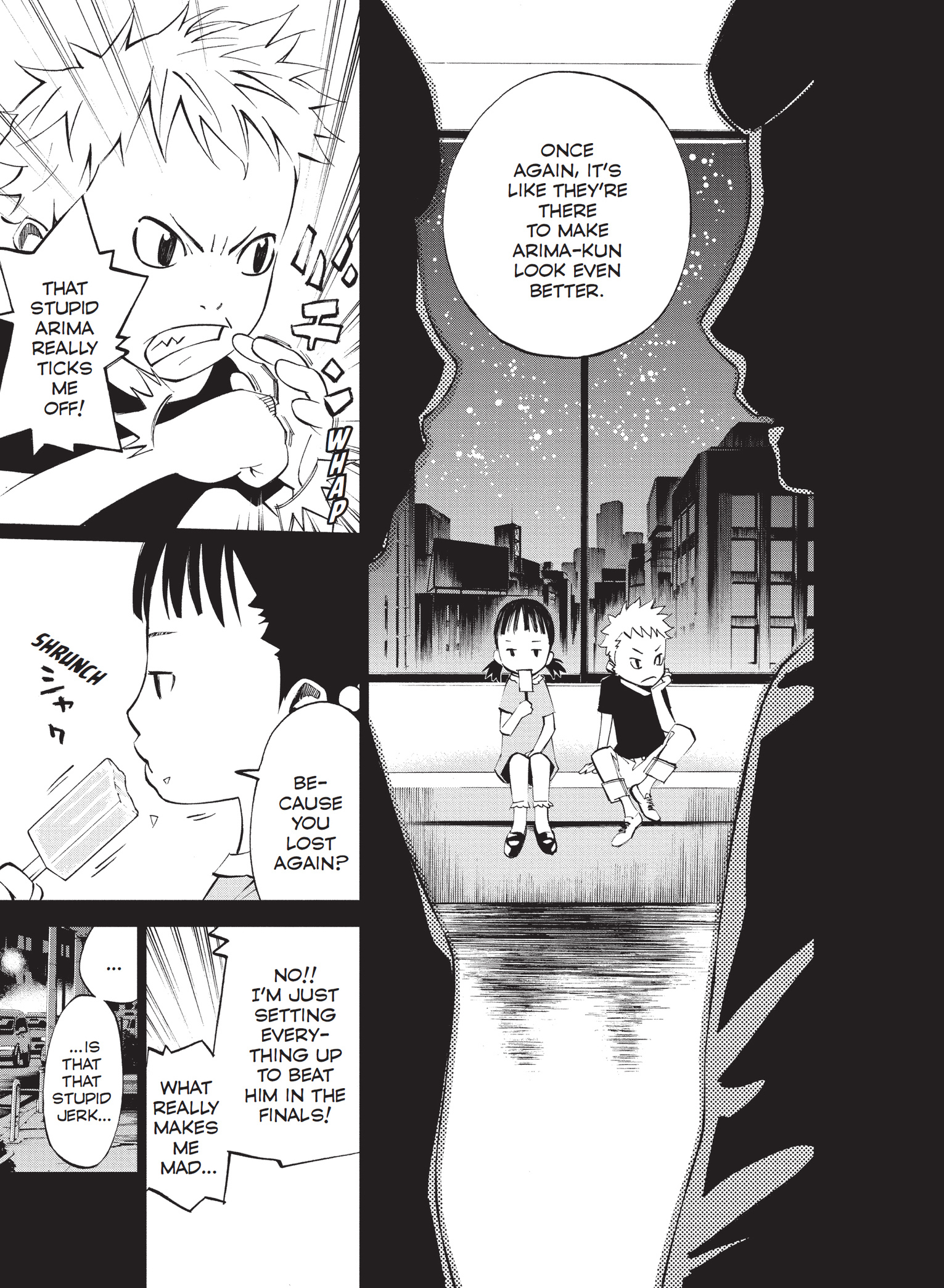

I’m so peeved that now there’s no way I could forget her name.
Emi Igawa.
A fourth grader, like me and Kosei.
She sees him as her rival according to Mr. Takayanagi.
“Takeshi, you’re sulking again. I can tell you’re skipping out on practice. It’s been a week since the second round—you haven’t played at all, have you? Don’t go losing your focus just because you made it to the finals. It’ll be much harder, you understand.”
This is how he scolds me when our first lesson after the second competition is done.
Then, when I’m about to say goodbye, he puts a Hero Transformation Belt box in my hands.
“This is from your parents and me. You practiced really hard this time. And even though the result was the same as usual, your effort was really something else.”
“…Thank you.”
“Now, show me what you’ve got for the finals. If you don’t stop Kosei, he’s gonna win again. All right?”
“O-kay.”
Me, stop Kosei? Nuh-uh, no way.
My teacher senses my thoughts.
“Takeshi, I mean it, you understand? If there’s anyone who can reach Kosei’s level and even beat him someday, it’s you. I think you’re the only one who knows how to win those scores from the competition judges and become unbeatable. But no matter how well the coaches know it, the players themselves have to get it deep down. And you do.”
Yeah, I give a half-hearted answer. Something’s not right. What do I want?
The piano competitions use a point-deduction scoring system.
The fair way is to judge whether or not the player played perfectly like on the music sheet.
It doesn’t matter how much personal feeling you put in or how much the piece means to you or the audience, you can’t turn that stuff into points and show it to other people.
That’s why the player’s skill at playing the song perfectly, the way it’s written on the music sheet, is what gets judged. The more different your playing is from the directions, the more points get deducted.
Mr. Takayanagi’s trying pretty hard to reach me.
“Your strength is that you’ve got real respect not only for the music, but for the composer, too—”
He looks like there’s something more he wants to say, but I say a quick thank-you, bolt out the door, and head home on my bike.
When I finished playing at the second round, my head was empty.
There wasn’t any sound in there at all.
Even looking at a piano just gives me this restless, unpleasant feeling that I can’t explain, and I can’t bring myself to open the lid. When I breathe the air by the piano, I feel like I’m suffocating.
I know the finals are coming up.
Maybe getting cut in the second round would’ve made things easier…
Now I have to get on stage again with that perfect sound playing in my head. The sound I wanted, the sound that used to be mine, that unbeatable sound—I’ve gotta pull it out from my brain, make the judges and the audience all hear it, and show ’em I’m the best.
Back to square one, huh? But my sound’s gone away.
Ugh, whatta hassle.
I wish being like Kosei was easier. I wish I could play like him casually, right now.
Just then, as I’m walking along the schoolyard, I see several boys from my class through the backstop net. They’re kicking and chasing after a soccer ball.
Somehow, it looks really fun. I stop my bike and watch them for a while, and when they notice I’m there, they wave and run over to me.
—Takeshi, tomorrow after school we’re playing our second game against Class One. You gotta help us out here. You know K-man went home early, right? The class health monitor said he had a fever.
—He could be out tomorrow.
—Don’t wanna push him too hard if he’s not a hundred percent, yeah?
—This is you we’re talking about, Takeshi. Just practice with us a little now and you’ll be good to go.
I’ve been so busy with piano that I’m not socializing much these days, but some of my buddies still want me to hang out. I almost say yes.
—If there’s anyone who can reach Kosei’s level and even beat him someday, it’s you.
In my brain, Mr. Takayanagi’s words come back to life. At the same time, the sound of a perfect piano starts playing.
It’s Kosei’s Bach. Da-da da-da-da da-da-da, da-da da-da-da da-da-da. Da-da da-da-da da-da-da, da-da da-da-da da-da-da. Do-mi sol-do-mi sol-do-mi, do-mi sol-do-mi, sol-do-mi.
That “Farewell”—which I’d thought was perfect—is gone now.
But Kosei’s Bach is back in my head. It didn’t go anywhere.
I listen to the music echoing in my brain for a while.
I wanna play perfectly too. To make everybody see. A sound that all the judges, the audience filling the hall—everybody—can see is perfect, a sound that represents the music sheet whole.
“Takeshi? What’s wrong? You’re spacing out.”
Da-da da-da-da da-da-da, da-da da-da-da da-da-da. Da-da da-da-da da-da-da, da-da da-da-da da-da-da.
Do-re la-re-fa la-re-fa, do-re la-re-fa la-re-fa.
Kosei was practicing so many hours over and over. There’s no way I can get the perfect sound skipping all the practicing that he’s been doing. If I’d done it, I’d have surpassed him a long time ago.
Da-da da-da-da da-da-da, da-da da-da-da da-da-da. Da-da da-da-da da-da-da, da-da da-da-da da-da-da.
Ti-re sol-re-fa sol-re-fa, ti-re sol-re-fa, sol-re-fa.
As I listen to the sound, I stare at the palms of my hands and then squeeze them tightly. I see the faces of all my friends. Yuuki, Kento, Sho, Yocchin, Reiya, Masa, Junpei…
I…
“I’m sorry…I’ve gotta practice piano.”
I put my hands together and apologize. “Okay…” they say, looking very disappointed, and go back to the center of the schoolyard.
I thought I’d made up my mind.
Once I face the piano, my friends playing soccer flickers on the back of my eyelids.
They looked like they were having fun. Without K-man, they might lose to Class One…
“Dammit, what do I really want?!” I shout. Then the sound echoes in my brain.
Da-da da-da-da da-da-da, da-da da-da-da da-da-da. Da-da da-da-da da-da-da, da-da da-da-da da-da-da. Do-mi, sol-do-mi, sol-do-mi, do-mi, sol-do-mi, sol-do-mi. Do-re la-re-fa la-re-fa, do-re la-re-fa la-re-fa.
I play the same song. I let all my ten fingers dance on the keyboard.
But when they touch the piano and the actual sound reaches my ears, I can’t ignore the gap between the two sounds. No matter how many times I play they don’t even overlap, and it gets hard to breathe.
It’s getting to be too much, and then I picture my friends’ faces and start worrying about tomorrow’s soccer match.
“No, I gotta play piano, that’s what I’ve decided. I know Kosei’s making an effort, and I know I need to try harder. If I go to sleep tonight without practicing at all, of course there’s no way I’m gonna wake up tomorrow and be the best…I know that!”
But I don’t really know. Would it be fun being the best? Would it feel great? If I became the best, would I not feel confused?
Frustrated, I stand up and start pacing in the piano room, looking all around. I notice the square-shaped bump in the backpack that I always wear to my lessons. It’s the Transformation Belt.
“I didn’t do it ’cause I wanted this.”
I pull the belt out of my bag together with the box, go to my room, and stuff the thing into the drawer underneath my bed. I don’t even open the box.
I don’t need new toys anymore. I’m bold enough to say no to my friends.
I just want that perfect sound.
The perfect sound…what does it mean?
Da-da da-da-da da-da-da, da-da da-da-da da-da-da. Da-da da-da-da da-da-da, da-da da-da-da da-da-da. Do-mi sol-do-mi sol-do-mi, do-mi sol-do-mi sol-do-mi. Do-re la-re-fa la-re-fa, do-re la-re-fa la-re-fa.
The sound of the piano in my brain, what is it really? Is it perfect?
Why does it feel so…hard to breathe?
Didn’t I always feel this way? Ever since I stopped playing with my friends and started practicing really hard four or five hours a day, and ten hours on the weekends. I’ve just been pretending not to notice.
I leave home, and bike on over to Kosei’s house. The only sound I admire is Kosei’s. I wanna hear his real sound. The sound he works so hard at.
Riding on an embankment along the river, I spot some kids horsing around on the bridge going across the water.
“Hey…that’s Kosei.”
I hold my breath and stop pedaling.
He’s having fun with a shorthaired girl. They’re diving into the river from the bridge rail over and over again. The other kids are hooting and hollering, too.
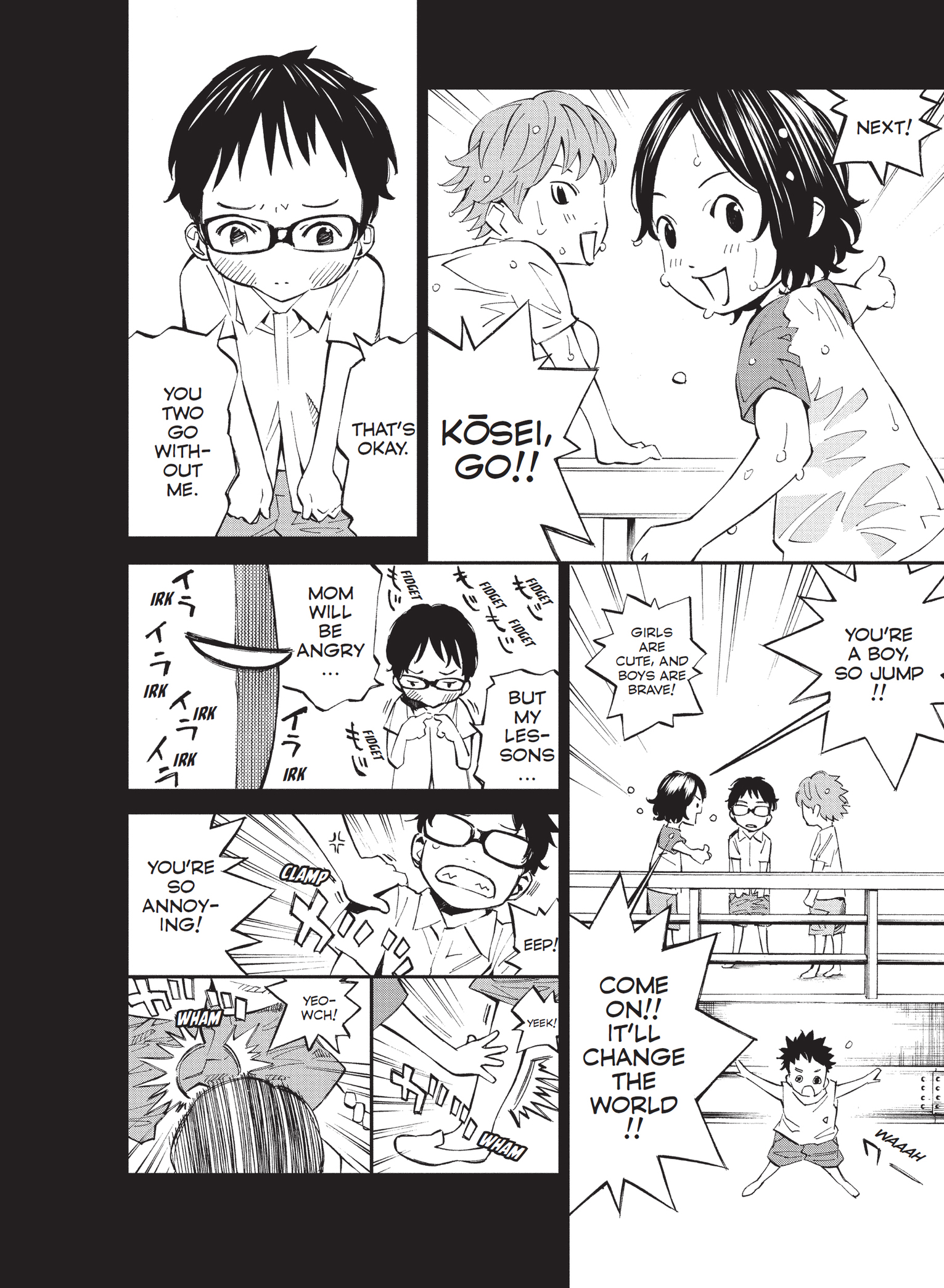
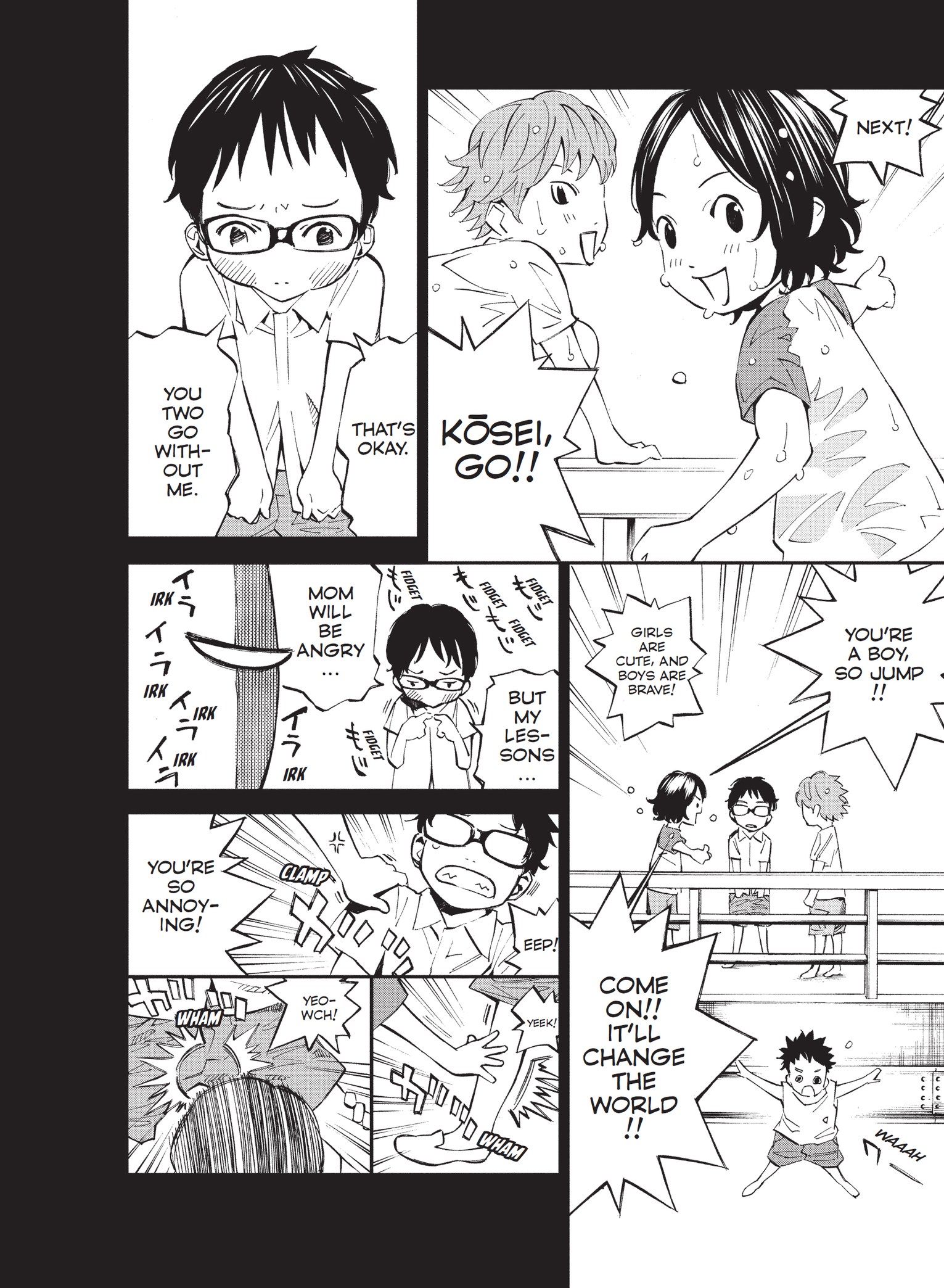
Kosei plunges down with a huge splash. As the water sprays all around him, little particles of light burst as well.
“Wha…”
What the? Wait…huh?
He’s…Kosei’s playing with his friends? Why’s he laughing so much?
I stand there stunned for a while, still straddling my bike.
He comes out onto the riverbed soaking wet, cackling and smiling with the other kids who seem to be his friends. He wipes his wet forehead and cheeks with the backs of his hands.
…Kosei is having fun, like an ordinary kid.
The dipping, golden sun is reflecting off the surface of the river. It’ll be autumn soon.
All of a sudden, I feel like I can hear music coming from the sparkling river. It’s Kosei’s piano and his even notes. It’s also coming from the autumn wind shaking the blades of grass on the riverbed, from the shiny puffs of clouds in the sky that’s starting to change from blue to yellow.
I want to laugh now, too. So I do. All by myself.
I laugh and laugh, and then take a deep breath.
It feels like the air reaches to the bottom of my belly, for the first time in so long. The autumn air is a little chilly.
The next day, I go around to all my friends asking to play, and they let me in the soccer match against Class One after school.
I don’t score, but I have a couple of assists, and one of them nets a goal.
The whole time during the match, that beautiful piano sound with its even notes, crystal clear, echoes from deep inside me.
My body feels so light somehow.
I shout out loud, cheering my friends on.
I run as fast as I can from corner to corner on the field.
We win the match three to one.
When I get home, I’m gonna start playing piano again tonight—with this lighter body of mine.