#2: Kosei’s a Liar Emi Igawa
# 2  Kosei’s a Liar
  Emi Igawa
Ever since that day, I keep on getting betrayed by Kosei.
Trusting him might’ve been a mistake, but Kosei…the Kosei I see now, that’s not the real him. Absolutely no way.
Why? Why does nobody notice—not even Kosei himself?
It’s autumn, and I’m a fifth grader.
I’m at the concert hall for the district preliminary of the Saiki Piano Competition.
I’m looking at the monitor back stage, thinking the same thing over and over as I stare at Kosei’s hands playing the piano. He got picked to go last, as a seeded contestant, because he’d won the competition last year as the youngest winner.
He betrayed me again. Why is he doing this? It’s just gonna make the audience dislike him even more. He should just go back to being the Kosei he used to be. Why’s he always gotta act the bad guy? Is it fun to play the villain?
Kosei keeps playing perfectly. He’s doing a Haydn sonata—the Piano Sonata in A major, Hob. XVI: 26, 1st movement, Allegro moderato. We all had to pick a set piece song in the classical style, one of the designated sonatas by Haydn, Mozart, or Beethoven.
I remember that at the final round of the Nagai Memorial Competition last month, too, he played Haydn’s Piano Sonata No. 43 in E flat major, Hob. XVI, Finale, and won without making any mistakes. I’ve been so focused on the Saiki Piano Competition that I didn’t take part in that one.
He picks the hardest songs on purpose, ones the other kids would never, and plays them perfectly to snatch first place. That’s been Kosei over the past six months…after he got to fifth grade. Without taking any breaks, he shows up at every competition, and just about every month he gets another certificate for passing a prelim, another championship award, or another trophy.
“The trophy thief”—that’s what he’s called these days.
“Emi? There you are.”
It’s my piano teacher Yuriko Ochiai. She comes over to me.
“You’re watching Kosei again, aren’t you? Does he bother you so much?”
“…Yes.”
“And since he picked a different song from yours, it’s bothering you even more. Why do you care so much about winning with the same song he’s playing?”
“Do you think I can beat him?”
She gives me a vague smile, and only says, “Do your best.” It’s been this way for a long time, like for a few years.
“I didn’t think he was gonna play Haydn again. I was sure he’d choose Beethoven’s Op. 27 No. 2, 3rd movement. That song’s really intense, so he can show off his techniques.”
That’s why I played that piece.
I’d practiced really hard, and I created my own image for it. Even after I checked the program and realized that we’d picked different songs, my passion didn’t go away—it still drove me on. Like a tempest, harder, faster and faster, I pulled off the distinctive arpeggios like I was in a frenzy.
It frustrated me that I couldn’t fight him head-on, but I played with my whole heart, showing them how much I wanted to beat Kosei and how intense my passion for piano was.
My piece—the 3rd movement of Beethoven’s Piano Sonata No. 14 in C sharp minor, Op. 27 No. 2, Presto agitato. The popular name for it is “Moonlight Sonata.”
You hear the calming 1st movement of “Moonlight Sonata” a lot on TV as background music. The “da-la-la, da-la-la” is played by the left hand, accompanying the main melody that goes “duum, dah, da-duum,” which is played by the right hand. This 1st movement is a favorite for people who just enjoy playing piano once in a while.
For competitions, more technically difficult songs get chosen. The 3rd movement is perfect for a set piece because it has just the right amount of difficulty and intensity. Presto agitato—play faster, and harder—that’s what Beethoven says.
…Kosei finishes playing Haydn’s sonata and bows to the judges and the audience. He gets a round of applause. But not like the one I got—not that loud.
For me, the audience was so excited and their clapping showed more enthusiasm. The entire hall was far more filled with applause.
There was a sparkle in their eyes. But now—for Kosei? I don’t think so, no way.
“That was a splendid Haydn, following the sheet completely and with no mistakes. He’s like a machine…Oh, I guess you’ve already heard this hundreds of times. I’m tired of saying it, too.”
Miss Ochiai gives a wry smile. I bite my lips. Now I’m way madder.
Why didn’t he choose “Moonlight”? Even right this minute, I want him to do it over, with my song. And I wanna know which one of us gets applauded more, excites the audience more.
I played with my whole heart, with all the energy I had. I felt so high until I finished playing and got applauded. But now, I feel empty…
“Emi, you really are upset, aren’t you? Just because you guys played different songs…”
“Do you think I could’ve won if he’d played the same song? I mean, in my performance today, I played so hard and with so much energy that it made me feel really good. It was strong like a scream, but also soft like a whisper.”
My teacher looks away from me and also changes the subject. “Competitions are difficult, you know. If you played Beethoven all the time, they might think that’s all you knew. Even when Chopin is supposed to be your set piece, and you don’t have a choice, they get tired of hearing just Chopin. No matter what you play, they’ve adopted this cold, harsh mindset, and the hurdle keeps getting higher. A ‘trophy thief’ has to face those voices, too. In fact, there was a pianist in Europe who was called that, and at one competition, he ended up in second place even though his techniques were the best. What do you think he did at the gala concert?”
“Did he boycott it?”
The teacher shakes her head, and after confirming my reaction, answers, “Instead of the designated song in the program, he played a very famous one that everybody knows. Even people who aren’t into classical music have heard at least its first theme.”
A song everybody knows…what? “Für Elise”? “Traumerei”?
I can’t come up with the answer.
“Which one?”
She tells me with a straight face, “Chopin’s Piano Sonata No. 2, 3rd movement.”
“…Oh, ‘The Funeral March’!”
The familiar song instantly plays in my ears. Dum-dah-da-duum, dah-da, dah-da, dah-da, duum.
“That’s so sarcastic.”
“Right?” my teacher says, chuckling.
I feel like I want to play “The Funeral March,” too.
I know it’ll be Kosei who comes in first, while second place will probably go to Takeshi Aiza.
Takeshi used to be an okay player but started getting a lot better since last winter, and at the Maiho Music Competition held between summer and autumn this year, he breezed all the way through to the final. He nabbed one of the top spots, even if it was the lowest one. Up until then, even getting through the second round was hit or miss for him.
It was Kosei who came in first.
For me it’s always the same. This past year or so, it’s like the third-place spot for our district’s been reserved for me, behind Kosei and Takeshi. Before that, I was going back and forth between second and fourth place. So when Takeshi shot past me, sure, it kinda bothered me, but Kosei’s been my only rival.
Still, I didn’t forget to glare at Takeshi.
But today, I didn’t even get to face off against Kosei. ’Cause we ended up picking different songs. So there was no way the audience could compare us.
Even worse, this was twice in a row that we went with different songs.
Next time, I’ve gotta be more careful with my guessing.
“Okay then, let’s go,” Miss Ochiai urges. “That’s it for the first round.”
When Miss Ochiai and I go out to the open foyer in the hall, Takeshi starts talking to me. He’s already changed out of the suit he was wearing for the performance, and now he’s dressed in something loose and casual.
“Oh, Emi. The results have been posted. They came out pretty fast this time.”
He points to a corner of the list. Ever since he made a habit of coming in second behind Kosei, he’s started talking to me more. I have no idea why.
“Okay.”
I look up at the list hanging on the wall showing who qualified. I’m in third place, just like I figured. First Kosei, then Takeshi, then me. I’m sure it’ll be the same thing in the second round. If Takeshi makes a mistake and I don’t screw up, we might switch places, but it’ll still be Kosei in first place. I can already see myself being disappointed in the final.
That’s the level that the judges think I, Emi Igawa, am at right now.
How come you gotta play exactly what’s on the sheet, like a machine, to win these competitions?
Is that the only standard these judges go by?
You can fill the song with emotions and a message, express yourself by playing with all your heart and soul, and even move and touch your audience, making your sound linger in their hearts, but none of it will help your score.
Emotion doesn’t translate into numbers. Because everybody has a totally different way of feeling.
But I can’t accept that.
I believe piano should be something that moves you.
It was Kosei who first moved me with his playing.
Kosei, who’s the same age as me. I encountered his piano for the first time when I was five.
One Sunday at the end of summer, I was invited to a concert that a preschool buddy of mine was going to be in. I didn’t know what it was, I just went.
Thinking back to it now, it must have been a recital organized by private piano tutors who’d rented the hall together. Most of the performers were preschool to elementary. The girls looked so happy to have a chance to wear a frilly princess dress, and the songs they played were just arrangements of anime theme songs and pop hits.
Even the anime songs I knew got boring when the recital turned out to be two hours long. I’d almost fallen asleep when Kosei showed up on stage.
The song he played was so cheerful and fun and energetic, it seemed to twinkle.
But it wasn’t only cheerful—sometimes it got gloomy, too, like when the sun gets covered up by thin clouds. The melody was somehow sweet but also a little bitter, and it stayed in your mind.
I didn’t even know the name of the song at the time. I found out about three years after I started playing piano. One day my teacher said, “How about we do this one next?” and played it for me. That was the one.
Mozart’s Piano Sonata No. 3 in B flat major, K. 281, 3rd movement, Allegro (rondo).
The song has a radiance to it—like a flower garden in midsummer, where all the flowers are blooming proudly for all their lives’ worth, and the sun’s shining down on them—and also this light shadow that’s sweet and sad and sort of tickles your heart. That kind of mood is unique to Mozart.
When Kosei played it, it seemed like so much fun, he seemed to love playing piano, to love its vibrant tones. That’s what came across to me, and every single note sparkled.
When he finished playing, the music lingered and seeped into the audience.
I didn’t want the sound to fade away—the beautiful shiny sound, the wonderful tones that bounced with joy and yet wrapped around you gently. It felt like I was surrounded by lovely flowers, enchanted by their scent, and it amazed me how that feeling stayed inside me. My heart wouldn’t slow down, and somehow I just couldn’t hold it in anymore. My eyes welled up with tears, and all my feelings burst out at once, and I started bawling.
I was just…so moved.
The piano playing of five-year-old Kosei Arima embodied the joy of music.
That was it.
I wanted to play the piano like him.
I wanted strangers to be touched profoundly by my performances.
That Sunday…I let go of a future of endless possibilities.
When I got home that evening, with my eyes red from crying, I took my parents out under the rosy sky. They tried to keep me under control but I shook free and went to the highest spot that I could climb to by myself at the time—the top of the jungle gym in the children’s park near our house. I thrust my hands toward the red sky and shouted at the top of my lungs.
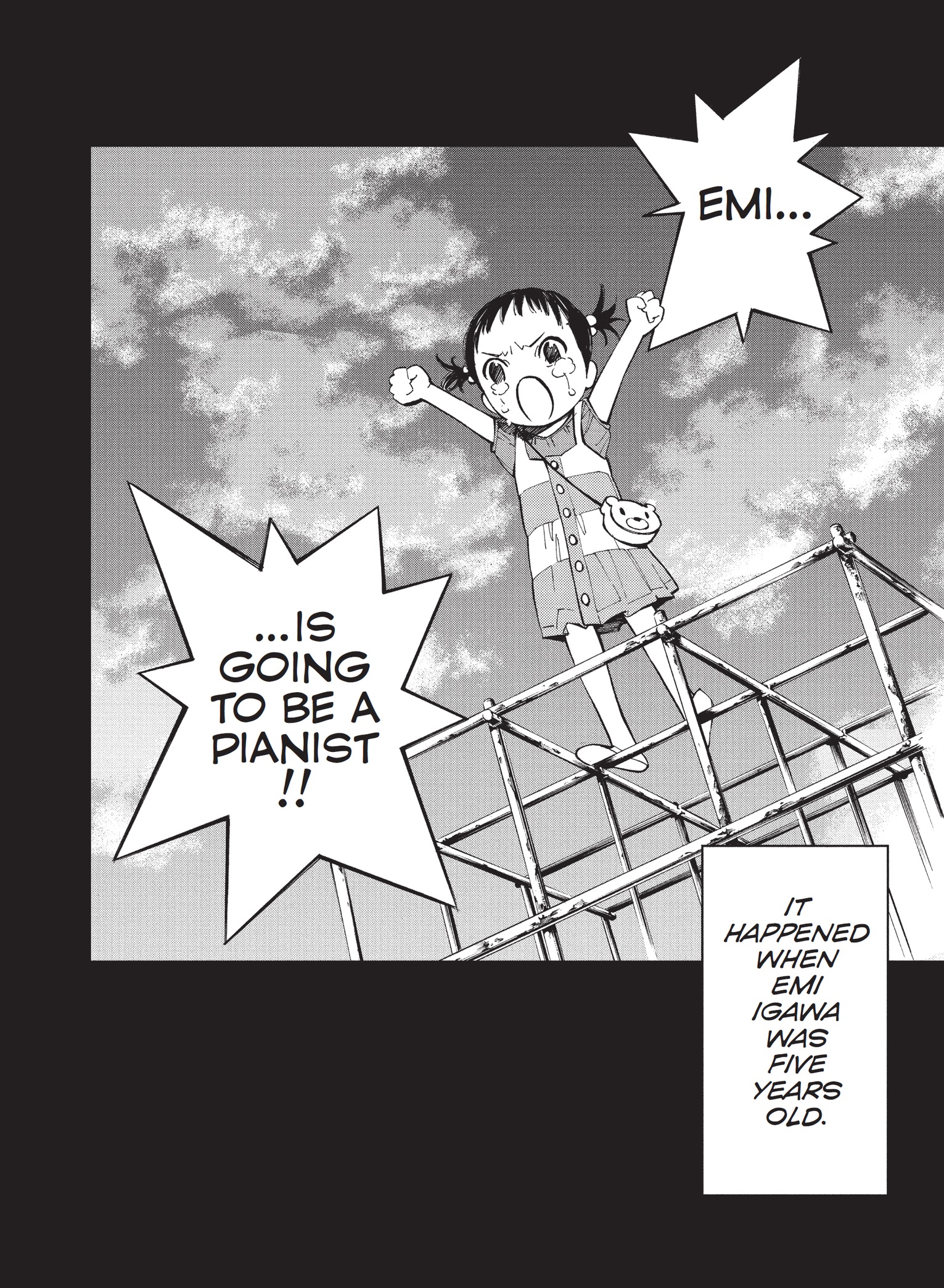

“Emi is going to be a pianist!!”
One after another, noticing that the results of the first round have been posted, the other players start filling the foyer. They’d been lurking in corners, anxious to see how they did.
—I made it!
—Uh, I knew it.
—I wish my fingers hadn’t slipped at that one part and screwed me up…
—All right! Finally made it to the second round!
At competitions, there’s a golden rule:
Don’t make mistakes.
Only people who avoid making the kind of big, obvious mistakes that knock down their score have their names put up, and even then, they have to see themselves ranked.
The area in front of the results is jammed with kids, some thrilled, some disappointed. When I step away, Takeshi follows me and says something.
“Anyway, we did a good job, Emi.”
Miss Ochiai quietly slips away. I spin around to look for her and see her signaling with her eyes. She wants me to talk to Takeshi?
“Kosei won again,” he says. “Perfect and flawless like always, right?”
For some reason he sounds so glad when he says it that it ticks me off. I can’t help sounding aggressive when I answer him. “Excuse me, but aren’t you upset?”
“Relax. Of course I’m upset, but I figure there’ll be more chances to compete. Let’s just say I’ve still got him in my sights.”
“So he’s your target.”
“Say, Emi, you and Kosei didn’t play the same piece this time. Seems like you guys always do.”
“…I try to. I guessed wrong this time.”
Takeshi blinks at me, looking confused. “You mean, you do it on purpose? Whoa, that’s ballsy. When it happens to me I get freaked out. It’d be so obvious—how much more he practices, I mean.”
“When I hear your piano, Takeshi, no matter how you play, it never makes me sad. But with Kosei, the more perfectly he plays, the sadder I get. Like it hurts to listen to. Don’t you think so?”
He tilts his head. “You can think whatever you want when you’re playing, but in the end what matters is whether you play it right. Sure, the amount you practice or the shape you’re in can affect how you sound…but Kosei’s playing doesn’t sound painful to me.”
“It’s like he’s saying, ‘I’m trying hard so accept me. I’m doing my best to play like it says on the sheet, I’m not thinking about anything else, I’m not adding anything that doesn’t belong or leaving anything out.’ He’s saying being correct is all that matters. He doesn’t have any thoughts or strong feelings about the song, and there’s nothing he wants to say through it, nothing at all.”
His mother’s puppet, a robot doing just what his mama tells him, an unfeeling slave to the sheet music—those are the things that the audience says about the “trophy thief” Kosei. Apparently, his mom majored in piano at a music college and studied under a famous professor.
She couldn’t make it as a professional pianist and ended up teaching at a music school. She pushed her failed dream—of flying around the world as a pro—onto her son, or at least that’s the rumor among the people who come to the competitions.
I only happened to hear that recently, too. But it has nothing to do with why I hate the way he plays ever since he started elementary school.
I just can’t stand to listen to him now.
His playing doesn’t shine or sparkle. And no light means there’s no shadow, either. It’s totally flat, and it’s got nothing you can grab onto, like a surface you just skid on.
He tries his best. He plays the song correctly. If the sheet music says pianissimo, he touches the keys gently. If it says sforzando, he hits the key especially hard on just that note. He’s careful to play the smooth slurs differently from the sharp staccatos, and he steps on his damper pedal to hold his notes, just like the symbols say. For him it’s like, I have to play correctly, just like the sheet music tells me, don’t I? I’m not thinking about anything I shouldn’t be…That’s how boring his playing is. It’s so stiff that I feel suffocated just listening to it.
That’s it—his playing tells me he’s not enjoying it at all!
There’s no sense at all that he loves piano and wants to share that love with his audience.
If his playing let you know he had a fire in him to win, it wouldn’t be so suffocating.
I say, “Maybe he does wanna be a machine with no feelings.”
“Nah…that can’t be, can it? I mean, he’s human. I’ve seen him playing with his friends and stuff. He was laughing.”
Takeshi sounds confident, but it’s news to me.
“Then that’s even worse! He can play piano like it’s so much fun, he can make his sound come alive, all sparkly and shiny—I know he can. You don’t know the real Kosei, do you, Takeshi? His playing during his first recital, back when he was five, that was the real him…but he’s turning into a machine! A robot just spitting the music sheet back out!”
Takeshi smiles, surprised. “The real Kosei, huh? The only Kosei I know is the one who doesn’t make mistakes. Okay, say he stops only playing what’s on the sheet like he does now and inserts his own interpretations into his piano. Even if he does that, he’s built up his techniques so much that he knows all the little ways he’s gotta be careful so the judges can’t dock him. Then he’d really be unbeatable, you know? Just means I gotta work harder.”
See you next time, Takeshi says with a raised hand. He goes through the automatic door in the lobby, with its glass walls that go all the way up to the ceiling. He walks towards the footbridge crossing over the rotary in front of the station. I see a couple of people who must be his parents standing on the bridge and waving at him.
As he goes off, Miss Ochiai comes over to me.
“I wonder how Takeshi improved so quickly? He also looks like he’s gotten taller. I guess that’s how it is with boys. They grow so fast, if you blink you’ll miss it, as they say.”
I don’t get what that means, but as she says it she takes her cell phone out of her bag and turns it on. At competitions, they ask you to keep it on silent.
“Oh, I got an email from your parents, Emi…They’re waiting in the parking lot. Time to go home. Don’t forget your bag, and put on your coat or you’ll catch cold out there.”


At the second prelim, I guess right. I see in the event program that Kosei and I picked the same piece. I’m so excited I could shout.
The options were the same as in the first round, but we had to pick a different one from last time. He and I are both going with Beethoven’s Piano Sonata No. 23 in F minor, Op. 57, 3rd movement, Allegro ma non troppo—better known as the 3rd movement of the “Appassionata.”
At competitions, it’s pretty common for Kosei to play something by Beethoven at least once if it’s an option. This time, he played Haydn in the first round, so I was sure he’d do Beethoven for the second…because in the final, we have to play one of the songs we did in the prelims, while the other one can be whatever we want.
That’s how I guessed. The judges chose fifteen out of Beethoven’s many sonatas (well, one movement from each), so I listened to them all, checked the scores side by side, and then very, very carefully picked my song.
Nailed it.
The same song. “Appassionata,” 3rd movement.
Even if I can’t place first, even if I get ranked under Kosei by the judges like always, the audience will know for sure which of our performances touched their hearts more.
That’s how I can show them Kosei’s way is wrong.
I don’t expect anything from the judges anymore. If I do, they’ll just disappoint me. There’s nothing I can do about the fact that there’s no other way to score us.
But I have a lot of other people, the audience filling the hall, on my side.
The size of their applause means they admire my piano and reject Kosei for playing like a machine.
I practiced hard over and over.
Allegro ma non troppo, instructs the 3rd movement of “Appassionata”—fast, but not too fast.
Still, there’s a hidden passion worthy of its nickname running through the song.
Passion—exactly the message I want to send. I want my feelings for piano to knock over the audience, and Kosei especially. I just wanna make them know that piano is a way to express passion and it should always be used to move people.
Forcefully…gently…forcefully then gently…tenderly yet intensely…That’s how I’m gonna play. I’m gonna make a sound that’s all my own.
With my image complete, I’m ready for the second round.
Kosei’s going last this time too, and I’m on right before him.
“This is the best stage. I’m so excited, I’m shaking.”
I say this to Miss Ochiai and then go on stage, actually trembling. I sit down, facing the black piano that’s there all by itself under the spotlight.
My playing starts off smoothly, with my wrists still nice and flexible. My fingers go right where I want them to be.
They’re dancing, wandering between the white keys and black keys, moving fluidly to the left and right on the row of keys.
My sounds are nice and loud, too. I’m calm enough that the strong ones and the soft ones are both coming through clearly.
Very nice.
My ideal sound resonates. My fingers, my hands, my body are creating a sound that’s my own.
This is my piano. Go on, listen.
I get past the part where the main melody switches from left to right and back to left, and then comes a whole rest. I put all my feeling into that silence.
Then there’s a chord played with the left hand that makes the silence stand out more—that’s where I make a mistake. All sound, including noise from the audience, has ceased, and enjoying it, I wonder, Did I stretch the rest out too long?
I forget to do the natural with my left hand on the next chord. I touch a black key. Right away I slide my finger to tap the white key, and the next moment I feel my heart pounding louder.
Then the pianissimo with just my right hand—is the sound not resonating? Now the half notes with my left hand. The way it sounds when I’m playing with only one hand makes me uneasy. I need a chord.
But the chord I wanted comes out muddy because my right pinky misses the key.
My passion is cooling. Anxiety takes its place.
Should I have played faster?
Should I have played louder and louder?
All of a sudden the keyboard feels chilly.
What felt as warm as my body temperature is so cold now and heavy, like it’s a totally different thing.
I’ve lost the connection between the piano and me.
What am I gonna do?
It feels like the sound I owned is slipping away freely through my fingers.
This piano won’t express my passion. I have no control anymore, it’s not singing with me. No matter how much passion I put in, it won’t get any better.
Should I have played more insistently as if to knock on people’s hearts?
Should I have played with a lighter touch, like a whisper?
Still confused, without recovering the passion that I meant to put into the song, or the connection that I had with the piano, I finish playing.
The applause is loud. But it’s not what they gave me for the first round.
—She couldn’t take the pressure.
—She got a little drunk on herself.
—I thought she played better than that.
—It was rickety, too strong or too soft at times.
—No, in the last part, she didn’t differentiate the strong and soft taps enough.
I feel like I can hear the audience muttering their carefree views. Everybody’s giving me a cold look…
…It’s all in my head, it’s all in my head, it’s all in my head…
When I go offstage, all Miss Ochiai says is, “Good job.”
Oh, so that’s all she can say…
My knees go wobbly. When they bend I almost fall, but my teacher grabs my right wrist in a flash.
“Oww!”
“Emi? Does your wrist hurt? You didn’t notice until now?”
I clench my teeth and nod.
It didn’t bother me during the performance. Well, actually, I did feel a slight pain whenever I practiced for too long. But I pretended like it didn’t hurt. Otherwise, I wouldn’t be able to play.
I’d miss my chance to show who I am to the crowd.
I’d miss my chance to reject Kosei.
“I think you should ice it, and make sure to go see a doctor tomorrow. All right?”
Kosei comes on stage after I’ve stepped down.
In the end, Kosei nabbed first place with ease to pass the second round. But I only found this out later. I don’t know whether the applause he got was bigger than mine. That’s because my parents, who were sitting in the audience, came over and found out and took me right away to a doctor they know.
I have tenosynovitis—that’s what the doctor says—from practicing too much. It has something to do with my hands growing a lot faster at my age.
So Kosei wins the Saiki Competition two years in a row, and I have to give up playing at the Zenkyo Competition in the winter.
While I’m recovering, my hands become bigger, and my fingers are wide enough to easily reach one octave of keys. I’m getting taller, too.
Meanwhile, Kosei has won two competitions including the Zenkyo, and he finishes in one of the top spots at the Urie International Competition, where most of the players are from overseas. This makes the second time, after last year.
It seems like the “trophy thief” is becoming more and more infamous. But there’s no player around his age in Japan who’s good enough to beat him. Takeshi’s getting better little by little, squeezing his way into the top spots at the finals after Kosei, but that’s about it.
My comeback starts in the summer of sixth grade, from the prelims of the Maiho Competition.
I pick my piece with all the resolve you’d imagine.
The options include Beethoven sonatas, like last time.
Checking the list, though, most of the songs are different from the ones at the Saiki Competition last year, which also featured Beethoven’s sonatas. Only one’s the same—the 3rd movement of “Moonlight.” I choose one from among twelve.
Beethoven’s Piano Sonata No. 8 in C minor, Op. 13, 1st movement—the 1st movement of the so-called “Pathetique.” The melody starts out sorrowful and goes on that way, true to the nickname “Pathetique” that the young Beethoven came up with. Then it turns into a melody full of poignant sentiment.
Right again.
Kosei picks it, too.
Before I even start practicing, I read the music sheet over and over to develop and complete my image.
One part sounds sorrowful, and another sounds furiously angry. I put words on the sheet, remembering my own experiences—how I felt when I was sad, how I felt when I was angry.
Like, when the soda-flavored ice candy I love was sold out and they only had the milk flavor and the chocolate flavor. But I wanted the soda flavor! Okay, so that’s the smallest sorrow and anger…
Bigger sorrow: Kosei’s betrayal.
Bigger anger: also Kosei’s betrayal.
The anger and sadness I feel at every competition when I listen to his piano.
I practice and practice over and over. I just play piano so hard.
Anger that comes from loss and anger in the face of absurd suffering are different. The playing shouldn’t sound like I’m punching the keyboard just because I’m mad.
It’s gotta resonate with the anger everybody feels for one reason or another.
I put all my sorrow, love, and bitterness into the piece, and it becomes a story. I try to play it so that it has breadth and depth. Not just strongly and boldly, but also softly and tenderly, like I’m petting the keyboard.
I read the music sheet again, making my image swell up.
And I play. I play and play, nonstop.
I sleep on a futon under my piano. I want my body to absorb all the reverberations remaining in the room, all my own passion that’s soaked into the walls with the sound.
The day of the first round…my turn to go on comes right before Kosei’s.
They have seats for the players on the stage wing. Five folding chairs are lined up, and we can wait our turn there, but few of us do. That’s because hearing the performances gets distracting and you start thinking too much. Usually, it’s okay if you’re there by the time the second person ahead of you is done playing.
If the person ahead of you plays really well, you’ll get depressed thinking you can’t play like that, and if he or she fails, you’ll feel anxious thinking that you’re gonna fail, too.
In the separate waiting areas for boys and girls—depending on the hall, the backstage rooms for actors, or meeting rooms with mirrors put in there—some of us read our scores or do image training. Outside in the hallway, others try to relax by rolling their necks or shoulders or by doing stretches. Some stroll back and forth or do whatever they think brings them good luck. There are all kinds of people here. It’s not uncommon to see guardians—usually parents—following them around.
Some people get pretty nervous as soon as it’s their turn to play and walk onto the stage clumsily and can barely bow to the audience. Others, relaxed enough to make out the audience’s faces at first, begin playing smoothly, but the second they think it’s going fine, the sweat starts pouring off them and their hands start shaking. It depends on the person, and sometimes the same person will behave differently at a different competition.
But everybody—every one of us—struggles with the pressure, and our tension at the max, we play our pieces trying our best not to screw up.
We don’t wanna make mistakes, so we practice over and over.
Everybody feels the same way.
I do, and probably Kosei does, too.
There I am—still looking at the sheet music even after moving to one of the folding chairs at the end of the stage, building up my image—when my name gets called. This is my moment to be in the spotlight.
As I fix the hem of my new blue dress, I stand and step forward, and out of the corner of my eye I catch a glimpse of Kosei, who’s sitting on a folding chair. His posture’s totally straight. He already looks like a machine, even before he starts playing. Every part of him is like a machine, a robot without emotions.
Having him in sight makes the flame in my heart flare up.
Kosei, listen to my sound, listen to my piano! I’ll make you fall in love with it! Real piano—I’ll make you realize what piano really means, so you’ll get serious about it!
My frustration when I couldn’t play piano for months, my joy that I can once again, my worries and hopes for the future—I pour all the different emotions bubbling up from the bottom of my heart into my playing.
Let my sound resonate.
Let my heart reach theirs.
Let me shine.
On the eighty-eight keys of the piano, my ten fingers run, and dance, and moan, and sing, and shout.
The piano echoes and spreads, answering my commands.
This is me!
My sound, and my passion, fills up the entire hall. It wraps every member of the audience and soaks into them.
Hear me!
Let it ring in your hearts!
This is who I am!
See? Piano is amazing, isn’t it?
Piano is beautiful, piano is fantastic. Piano can express everything that I am!
Listen!
Let it echo on and on!
I love piano, ’cause it lets me express myself!
The last notes quietly melt into the audience.
The sound lingers…there’s a moment of silence, and then the hall bursts into applause. Some people even give me a standing ovation.
I’m really proud of myself, and for the first time, I give a smile on stage.
I’m sure Kosei won’t get this much applause, or this much praise! My sound, my passion, reached everybody.
I bow deeply and return to the wing.
I glare at Kosei, who’s sitting in his chair.
He keeps his eyes lightly shut, not moving his body at all, like a doll. He’s not even trying to look at me, and he doesn’t feel me staring at him, doesn’t budge.
He didn’t feel anything from my playing?
Then…I feel sorry for him.
I’m surprised when that thought pops up in my mind.
Am I pitying him?
I am, I think he’s wasting his talent. What a pity that he doesn’t try to win applause, that he won’t be told that his piano is moving.
He’s missing out.
He could get them if he really wanted to, but he’s not trying. He’s definitely wasting his talent.
Sure…he’s doing it to get first place, but what’s he really thinking, deep down? Why is he playing piano? Did he lose who he really is…his love for piano? Why? Since when?
Kosei, you do love playing piano…don’t you?
I pass the Maiho preliminary in second place, which is my best result for this competition that I play every year. Takeshi comes in third place. It’s been a while since I last beat him.
Right before the results went up, I ran into Takeshi in the hallway in front of the waiting room. When we went to the foyer to see the results, people were groaning for some reason.
Well, it had to be because Kosei had come in first place as usual and people didn’t like it.
I’d put everything into my performance, no regrets, and was able to think that.
Kosei participates in the Shirase Competition half a month later, plays Mozart, and wins. But there’s a rumor that after he finished, he caused some trouble at the foyer before the results went up. He had an argument with his mother or something like that…
I don’t know the details. I can’t focus on my piano if I care about rumors—they just drag everybody down.
For the Maiho Competition final, too, I practice very hard so I don’t lose my rank. Some tough rivals come through the preliminaries from other places.
I’m gonna roll right over them and reject Kosei even more.
The song I pick for the final is Chopin’s Piano Impromptu No. 4 in C sharp minor, Op. 66, Allegro agitato—also known as “Fantaisie-Impromptu.”
I want something aggressive, something that would tear and shake me up, so that I can play with feeling and put my all into it.
But.
On the day of the final, I get the program as soon as I arrive at the competition hall, impatiently flip through it, and cry, “I wanted Kosei to play this song so much last year, why now?!”
He’s chosen Beethoven again. I was expecting he wouldn’t, that’s why I chose Chopin!
At least if we’d chosen the same Chopin, the audience could easily compare our playing…
He picked the 3rd movement of Beethoven’s Piano Sonata No. 14 in C sharp minor, Op. 27 No. 2, Presto agitato—or the 3rd movement of the “Moonlight Sonata.” It’s the piece I played in the first round of the Saiki Competition last year.
The one where I couldn’t get to face off against him.
But it’s gonna be okay, I tell myself.
If it were Mozart, it’d really be hopeless. Chopin supposedly didn’t release “Fantaisie-Impromptu” in his lifetime because the style turned out to be kind of similar to “Moonlight.” Both songs have the direction Agitato. So the audience at least ought to be able to compare which piano is more agitated.
“Okay…we’ll see how Kosei plays it. I know how I’m gonna play—aggressively, more and more aggressively, enough to show them how I feel!”
At the final, I’m set to play last. And ahead of the player before me is Kosei, who’s playing third from last.
I’m in the monitor room with Takeshi, who’s already finished playing a Mozart sonata and changed into his casual clothes. We’re watching Kosei’s performance on-screen.
“Moonlight,” 3rd movement, Presto agitato. Play faster, more intensely.
Kosei’s fingers press the keys precisely. They move to the higher sounds, and to the lower sounds, without any wasted motions. He never raises his hand up all dramatically or holds a sound too long when he should let it go—the sort of act you might put on to make yourself look “competent.”
Kosei, the same as always.
He doesn’t even show a fraction of an ounce of feeling. His tempo never goes wrong, not even by 0.1 seconds. Even with a fermata, where you can prolong the sound as long as you like, it sounds like it’s timed…It’s like he’s got a rule that if it’s quarter notes, he makes it three times as long as a quarter note.
“Isn’t it a little too fast? It’s precise, though…”
Just when Takeshi mutters this, the performance stumbles, unexpectedly.
It’s where his right hand starts playing the main melody. The trill, which is supposed to make the sound twinkle finely like an ornament made with all different colors of tiny gems, slows down. Wait, no—it didn’t slow down, he hit the key so hard that the sound was too loud. His finger did come away from the keyboard that much later.
“What?” Takeshi gets closer to the screen. “He’s playing faster and faster? The sound…it’s too loud. He’s not making it quieter for the decrescendo. Like he’s unable to control it.”
Something’s wrong, Takeshi says, frowning and crossing his arms.
It sounds so irritating. Kosei is even ignoring the directions on the sheet. The parts he should play quietly, and the parts he should play smoothly—all of them are breaking up and are disconnected.
No, no, this is all wrong. This isn’t the “Moonlight Sonata.” It’s just noisy.
Stop…
This is wrong, stop!
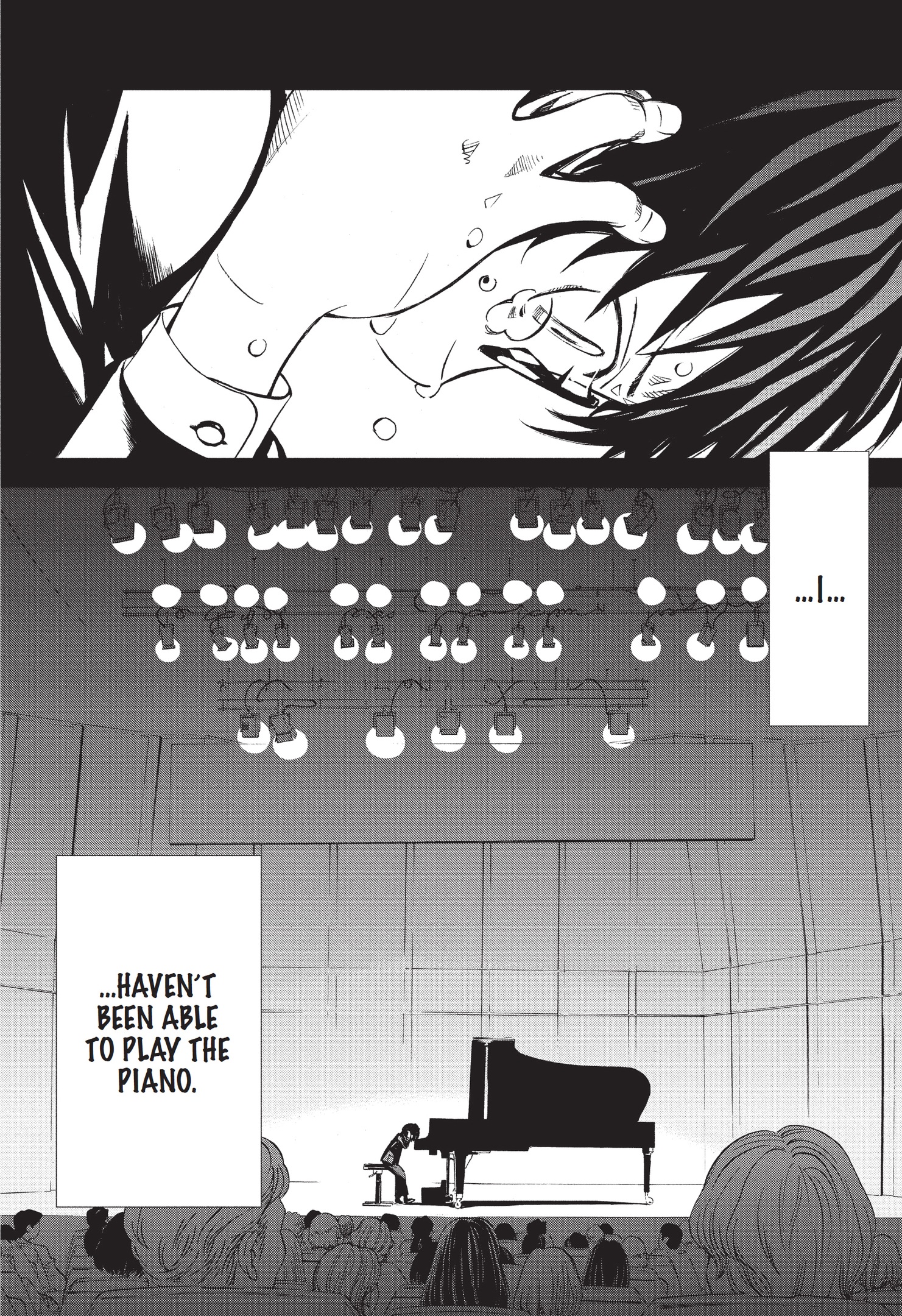
Suddenly—he does. He puts his hands on his head and looks down. He looks like he’s crying.
“No way…”
Takeshi’s muttering, more like moaning, snaps me out of it. I’ve been in shock.
No…this isn’t Kosei.
“It can’t be!” I shout, and my whole body begins to tremble.
What happened?
I can feel a chill running down my spine, little by little.
“Ahh!” Takeshi cries out loud and dashes out of the room.

Miss Ochiai rushes in, almost getting run into by Takeshi at the door.
“Emi!”
I’ve been crouching down without even knowing. She helps me get up and walk and takes me to the waiting room.
I don’t really remember what happened after that…how I played, I mean. It was like my mind was somewhere else, and I didn’t know why I was playing there, or what I wanted to express with my “Fantaisie-Impromptu.”
Kosei’s name wasn’t on the list of the final’s winners.
At the very top was Takeshi’s name, and mine was too, at the bottom.
Mine, when I’d played with no soul.


Kosei doesn’t show up to the next competition.
Or the next one.
Or the one after that.
I’m sure he’ll come back. There’s no way he can quit that easily.
Playing since you’re little, every day, hour after hour, and having so much of your life taken up by piano, it becomes almost like breathing.
That’s how it is for me. Kosei’s gotta be the same way.
I wait intently for him to come back.
Takeshi and I wait and wait for Kosei. We’re in middle school.
A year goes by, and the Maiho Competition comes around again. I expect to see Kosei at last—ready to make his comeback, looking to pick up what he left behind, to erase his shame. But he doesn’t show up.
This time at the Maiho Competition, as a first-year middle schooler, I barely make it through the first round. But Takeshi finishes in first place.
Every time I realized Kosei wasn’t there, I got depressed and lost my motivation, but I guess Takeshi wasn’t so obsessed with him.
Takeshi is standing in front of the list of players who passed the prelim and somehow looks frustrated by the results.
“Even when Kosei’s not around, you push yourself hard, huh?” I ask him.
“I’m gonna keep on winning. I’ll play perfectly, people will think my technique’s great, and they’ll keep comparing me to Kosei.”
His words kind of hit me by surprise. Takeshi is obsessed with Kosei, just like me. Kosei is his reason for playing piano.
But then, where’s Takeshi, himself, in all this?
Sure enough, the people looking at the results are saying:
—I wonder if Aiza’s gonna be another Arima.
—Who’d have won if Arima were here, him or Aiza?
—Nah, I doubt Aiza would’ve been a match for Arima.
Even though they’re talking about Takeshi, it’s still Arima this and Arima that.
“Is that what you wanna hear?” I whisper. “Just Arima, Arima, Arima.”
He grins. “As long as everybody’s comparing us, they’ll never forget Kosei. His perfect playing and his solid technique, I mean. That’s why I’m gonna play like Kosei on purpose, so they keep comparing me to him, until the day he comes back.”
Takeshi flashes me a thumbs up.
“I’m gonna keep his spot warm for him! That’s a good idea, yeah, Emi? I mean, Igawa?”
“Come on, you’re kidding me, right?”
“Huh?”
“Only you would ever come up with such an idea.”
“R-Really?” he says, looking happy.
I turn and look straight at him. “I think you’re right about keeping a spot for Kosei. I mean, our rivalry with him isn’t over yet. He’s gotta come back to exactly where he used to be.”
“Right…we haven’t caught up to him, and we haven’t passed him. There’s no way we can beat a guy who isn’t here. Don’t you think so, Em—uh…”
“Emi is fine.”
Takeshi gives me a big nod, and I nod back at him.
“See you at the next round,” Takeshi says and turns and leaves the hall, but as I watch him, tears fall from my eyes.
Being unable to play all winter, it really made me realize something. No matter what, I want to play piano. Piano’s the only thing that lets me express everything I am. Piano’s what I live for.
I play the way I do so people who hear me will never forget me.
I want to etch the memory of my piano into everyone’s minds—a sound that can’t be compared to anyone’s, a sound all my own.
Is it different for Kosei?
Can he just walk away? Kosei, can you really just walk away from it?
I turn back to look at the results which don’t have his name, glaring at them over people’s heads.
Kosei etched his sound in my heart.
The way he played at the beginning—was it just a lie?
Kosei, why won’t you show up? What did your piano mean to you?!
My bitter tears won’t stop falling.
How could he carve his piano into my heart and then just act like a machine, and even leave?
How could he just betray me when, all this time, I kept on believing in the real Kosei from that first recital?
He wouldn’t show me his real self and always lied to me. And just like that he disappeared.
“Kosei, you liar! You big fat liar!”
I stand still in the middle of the foyer and let my tears fall.
People pass me by in surprise, scrambling to avoid bumping into me, but I don’t care—I just keep standing there. I don’t even wipe my tears away.
Come back. Come back to me again, Kosei, you liar.
Even if you’re still a liar. Just come back…