Epilogue: You’re Amazing Kaori Miyazono
Epilogue  You’re Amazing
  Kaori Miyazono
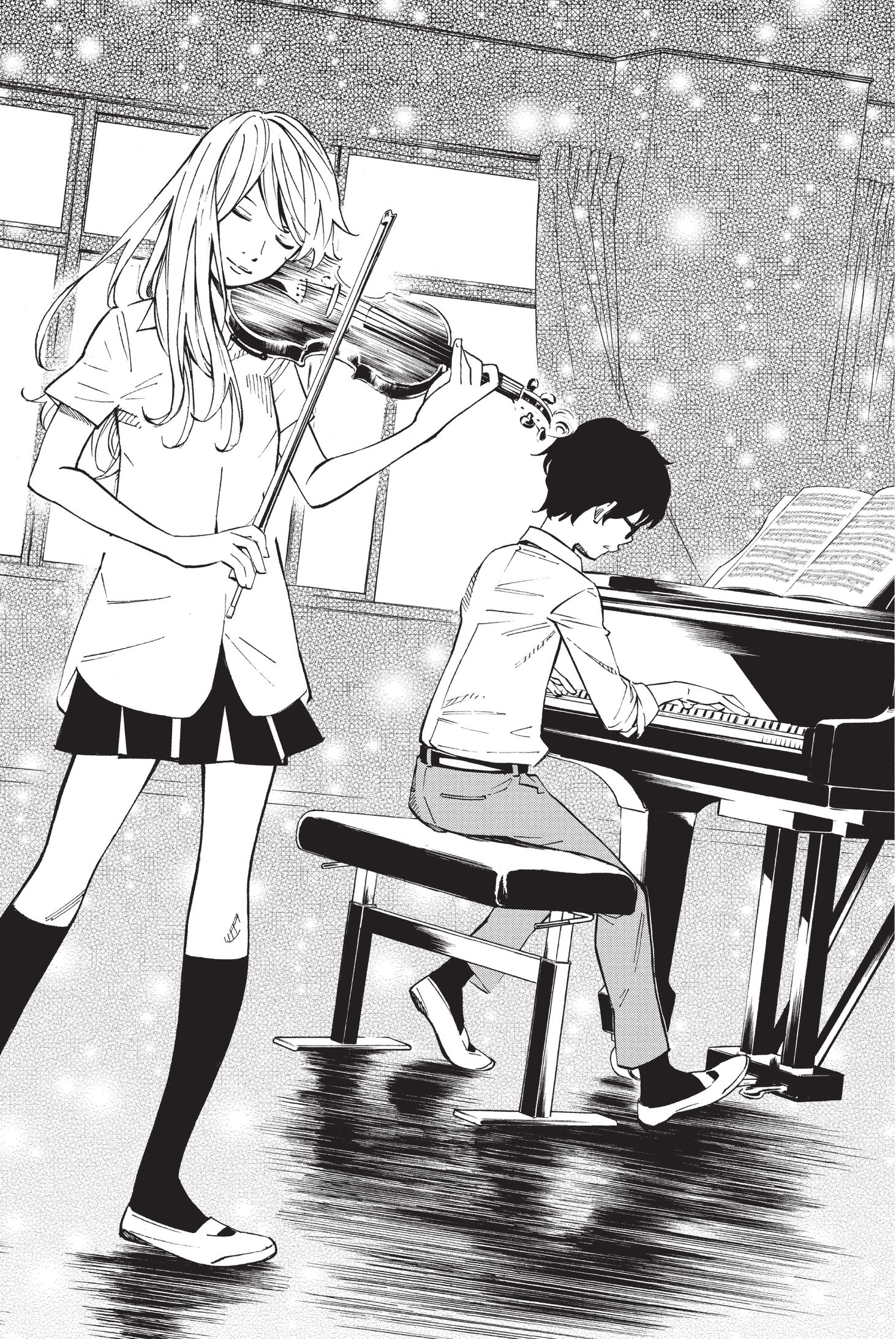
Here in the music room, only you and I are left.
“Okay, let’s start again! Get the tempo of your piano right this time. First, dum, da, da, dum, da, da. From the poco ritardando [gradually slowing down a bit], it’s duum, dah, dah. Slow it down like so, and then do the tempo primo [going back to the original speed], where you repeat that first dum, da, da.”
I tap the edge of the music stand.
“Yup, sure,” you mutter, seated on the piano chair, “if you keep that tempo for your violin, that’ll fix the problem.”
“Ack…I do more or less, don’t I?”
You reply calmly. “It can’t be ‘more or less’ for my piano to match well, you know? I keep the tempo precisely according to the length of the key on the sheet.”
“What, are you saying I have a bad sense of rhythm? Fine.” I go over to the CD player on the teacher’s desk. “Let’s dance and see which one of us has a worse sense of rhythm. You’re precise like a metronome, but you don’t pay enough attention to details like subtle shifts. That big head of yours is all full of logic—you don’t feel the rhythm with your whole body, do you?”
I pick up from beside the player the CD that I brought. I haven’t listened to it yet, so I’m really excited.
“What CD is that?”
“It’s ‘Love’s Sorrow.’ The violin’s played by the composer Fritz Kreisler himself.”
Your eyes open wide with surprise. You ask, “I knew he was a performer, but you can get an audio recording? Of course, since he was active in the twentieth century, after Edison, there must have been recording devices…Is that a remaster of the original record or something?”
“Yup. There are CDs for recordings from like a hundred years ago, but this one’s newer, recorded in 1938. And—it cost just two hundred yen at the big supermarket in front of the station three stops ahead of ours. I found it in the bargain bin!”
I walk towards you and hold out the CD case so you can get a closer look at the price tag. It’s on the plastic wrap. Then I tear off the wrapping.
“It was on sale ’cause no one wanted it? Feels even cheaper,” you say with a wry smile.
“Whatever. Forget people who don’t appreciate its value. For us, it’s an almost divine performance. If the composer’s directions on the sheet are absolute, like you say, then let’s find out if he followed his own directions when he played it.”
I pop the CD in the player, press the button, and choose “Love’s Sorrow.”
Amidst a bit of noise and kind of missing the echo, violin music starts flowing.
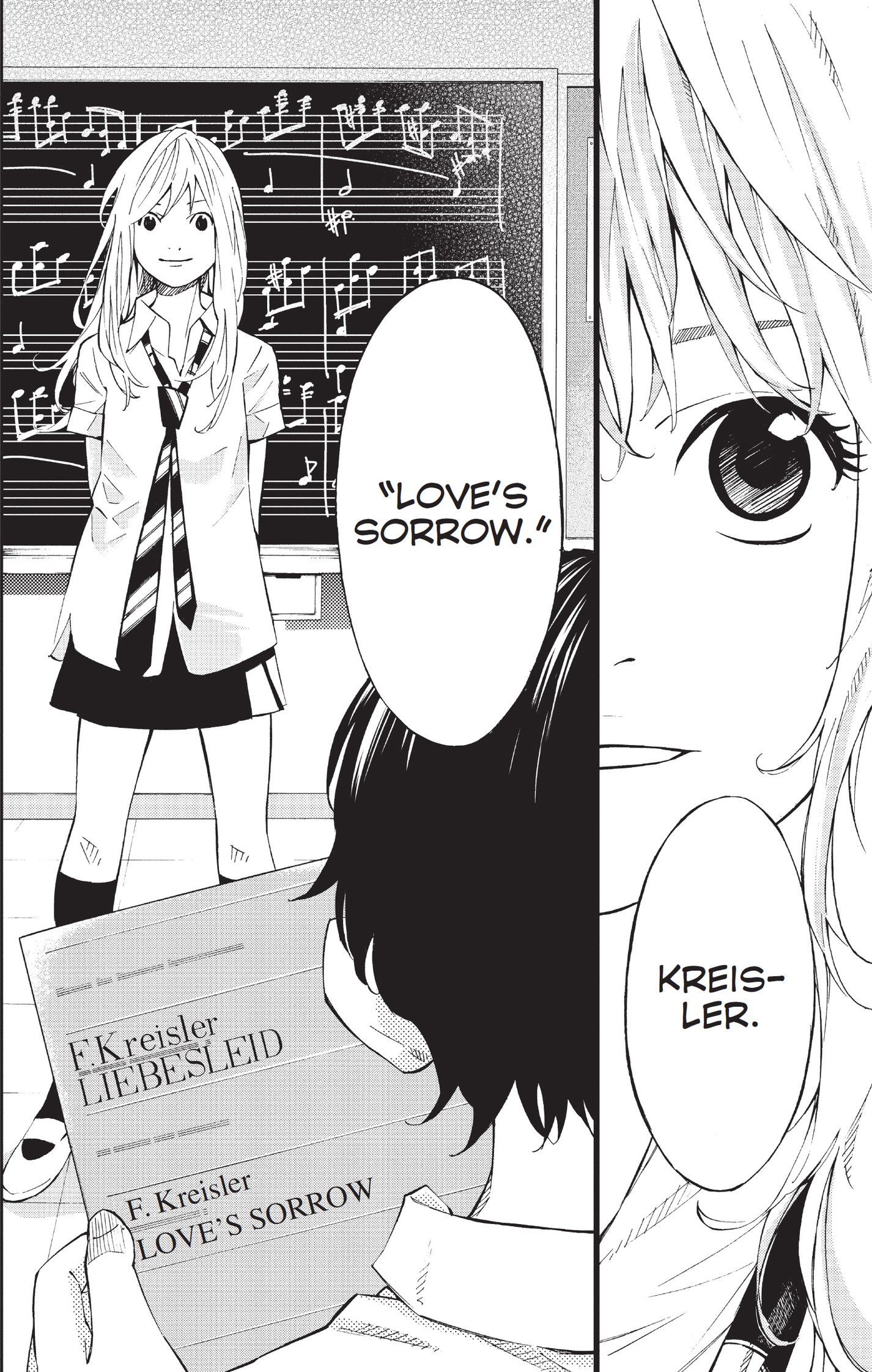
“Now, let’s dance. Let’s see about your famous tempo directed by the sheet. We’ll try to feel it with our whole bodies.”
I hold out my hand, but you softly, gently reject me.
“I don’t think we need to dance. We can figure it out just by listening.”
“This song was created as dance music, according to the composer’s own story. Just ’cause we’ve never danced a waltz in a castle in Vienna doesn’t mean we can’t dance. C’mon!”
But you just smile vaguely and don’t stand up.
“Forget it, I’ll dance alone. Watch.”
I press rewind to get back to the beginning and then start dancing, extending my limbs freely, as I please.
It’s a sorrowful melody, and the rhythm’s in triple time like a waltz. The little bit of noise adds a nostalgic note.
The directions on the sheet don’t tell you how many beats there are in a second or a minute. “Start with the Ländler tempo, then espressivo [play expressively]; imagining a past love, feelings pour out; slow down grazioso [gracefully]. Go back to the original speed. Repeat.” That’s all it says.
Ländler is an old kind of dance music in triple time that originated in and around Austria. I don’t know how fast it is, never having heard a real Ländler. I think it must have been leisurely like a folk song. It’s said that once the waltz became popular, Ländler fell off ’cause the tempo was too slow.
The direction that the composer put on the sheet says to mimic the tempo of an old tradition that vanished a long time ago, that nobody remembers.
So why worry about how many beats a second it ought to be?
Expressively, emotionally, gracefully—all you’ve gotta do is follow those directions and play at whatever tempo you like.
I pull off two elegant turns on my toes and finish by striking a pose.
You clap for me.
“That was wonderful.”
“Thank you.”
I bow, and when I look up you’re already facing the piano, your long fingers on the keyboard.
“I figured out the tempo,” you say. “I go with what the composer himself played at, right?”
You start, and it’s the exact same tempo as the CD, an almost punishingly accurate reproduction.
“Your turn—play your violin. At this tempo.”
I’m appalled by your direction, but I pick up my violin from the desk.
Overlaying the image that the CD gave me, I caress the strings.
They resonate, and the vibrations seep into my body.
Yes…little by little, your piano and my violin are meshing together.
You’re amazing. You’ve already grasped the tempo that feels best to me.
Your piano feels so good.
That’s why I wanna play for all I’m worth, of course.
You’re really amazing.
I’m so glad I could perform with you.
Laying my sound over your piano makes me happy. It’s so fun. It quickens my pulse.
My heart’s pounding. It’s almost hard to breathe.
You’re amazing. Amazing, all right?