Chapter Four: What You Joined Together

Chapter Four
What You Joined Together
1
“Who…are you?”
Not even he had expected the words that left his mouth. At the moment, Toshiki Miyamizu was being hauled up by his necktie. With eyes betraying his disbelief, Toshiki stared at the owner of the clutching hand, at something that was, in appearance alone, his daughter.
This wasn’t the question, Is this really Mitsuha? It was instinct that went beyond logic: This is not Mitsuha. This intuition that surpassed reason became a chill racing up Toshiki’s spine, turning his face pale.
This isn’t Mitsuha. It’s something else that’s taken her shape.
This wasn’t rhetoric; he meant it literally. It wasn’t a figurative expression that meant She’s acting like a different person.
A false version of his daughter, Mitsuha Miyamizu, had come to see him.
That’s ridiculous. It can’t be. It’s a trick of the imagination, stemming from fatigue. As these sensible words rose to the top of his mind, they were erased. The suggestion that it was an illusion floated constantly at the edge of his mind, like a tiny bubble, but it sank without ever gaining strength. After all, Toshiki Miyamizu had already arrived at an incontrovertible conclusion: This was not his daughter but something that merely looked like her.
He shuddered at that instinctive truth, and his mental functions had all but ceased. Right now, Toshiki Miyamizu was trembling in fear.
When his secretary had come and told him, “Your daughter Miss Mitsuha says she would like to see you,” Toshiki Miyamizu was in the mayor’s office at the town hall, reviewing some documents related to road paving. When he glanced at the window, it was bright outside, still too early to consider evening.
“She was very serious, and she seemed tense,” his secretary had said.
With no recourse, he’d agreed to see her for just five minutes. Mitsuha was one thing, barging into his workplace without an appointment, but the secretary shouldn’t have shown her in over something like this, either.
Here, too, he sensed the influence of the Miyamizu family, which had had roots in this area for a very long time, and it irritated him.
His secretary knocked on the door again, and Mitsuha entered behind him. The secretary left the room.
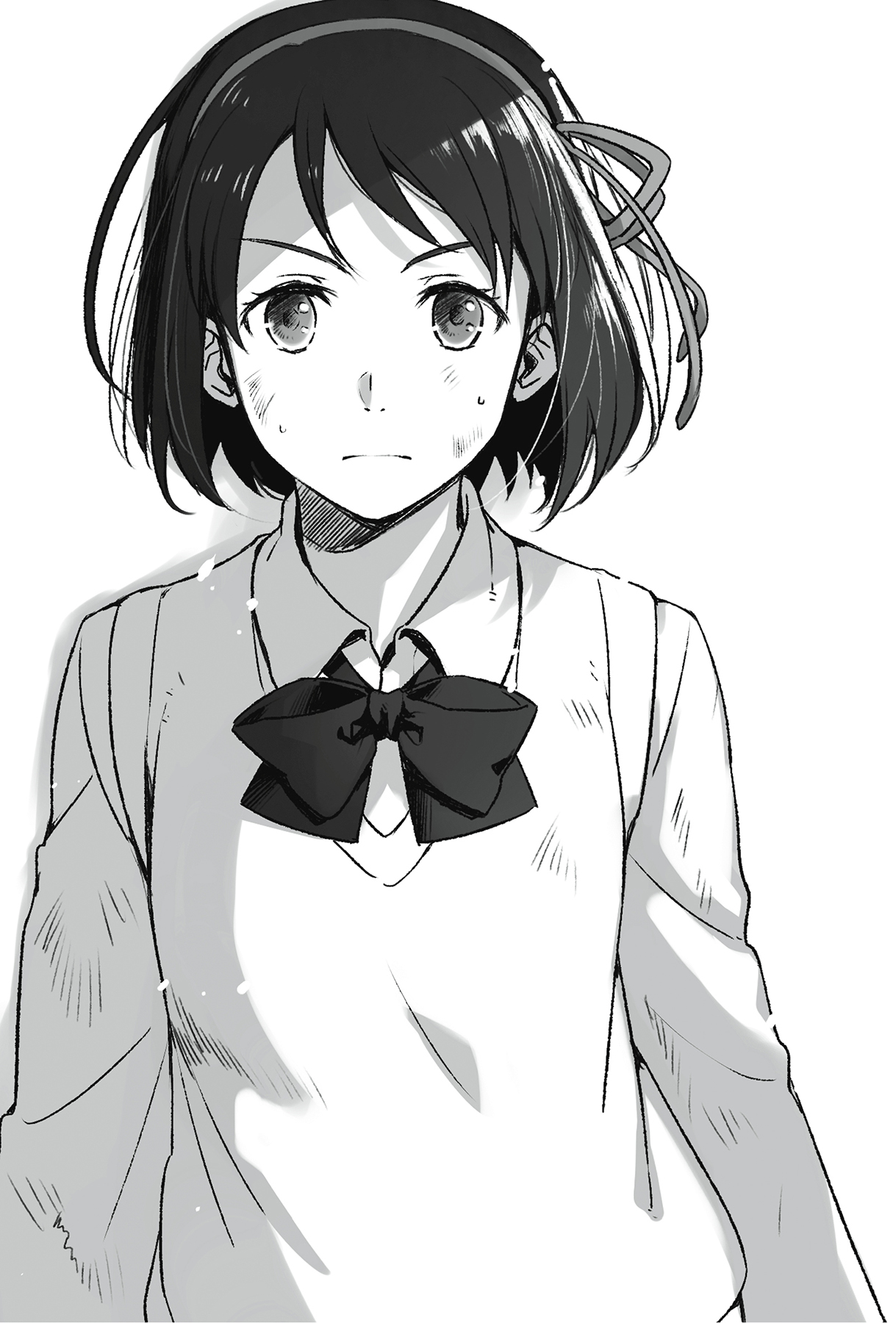
There was no telling when, but Mitsuha had cut her long hair into a bob.
Did she come to get a compliment on the new hairstyle?
Toshiki had a good mind to give her a sarcastic comment, but deciding that it would be terribly immature, he restrained himself.
For some reason, being around Mitsuha always provoked childish behavior in him. She dragged his honest thoughts out of him.
It was true that the Miyamizu women tended to do things like that, and he felt threatened by it.
He was acting as a local politician in order to rid this town of that menace. That was why he was there, living apart from his daughters.
The mere fact that Mitsuha had come there was unpleasant.
No doubt she’s planning to say more vague, fantastical nonsense, Toshiki thought, and sure enough…
Today, in a few hours, a comet would split in two, and one of the pieces would fall on this town, so she wanted him to evacuate the townspeople right now. That was what Mitsuha declared. Apparently, if nothing changed, about five hundred people would die instantly.
It was so hilarious he didn’t even smile.
Toshiki wasn’t interested in astronomy, but according to what he’d heard from the staff, a comet with a twelve-hundred-year cycle would be making its closest approach to Earth today.
The girl had probably seen a news item to that effect on television, promptly used her vibrant imagination to come up with a Hollywood-type story, and then begun to believe it herself.
She may be my daughter, but dreaming while you’re awake is a terrifying thing, thought Toshiki.
He couldn’t take these waking fantasies the Miyamizu women saw.
“Do delusions run in the Miyamizu bloodline?”
He said the words aloud.
He told her she was sick and decided to dial the number of a hospital he knew for emergency response purposes. When he picked up the receiver and started pushing buttons, Mitsuha moved quickly, closing the distance between them. In response, he looked at her just as she grabbed his necktie across the desk and pulled him down. His daughter’s eyes, blazing with anger, were right in front of his face. The moment he saw those eyes, he heard his own lips utter a small “Wha…?” The shock hit his brain and heart first, and only later did he understand what it was that had stunned him.
Up until that moment, he’d had no doubt that the person in front of him was his own daughter.
Spinning on their heel, the person who’d come to see Toshiki Miyamizu quickly walked away. That way and that gait did not belong to Mitsuha at all.
Toshiki flung himself into his leather-upholstered chair and loosened his necktie.
Once he felt the sweat on his forehead, he wiped it off with his fingers.
His head was still numb.
What had he seen?
He closed his eyes.
Had he really been this vulnerable to fear?
His mind didn’t think, What was that? or How could something like that happen?
In that moment, his breath had caught, and all his muscles had seized up.
The echoes of that thing still lingered within him.
So that’s what it’s like to encounter a monster.
Toshiki Miyamizu was a former folklorist. It would have been safe to call him an expert in this class of phenomenon. Depending on his research theme, from time to time, he’d search documents for tales of monster encounters and collect stories directly from people who said they’d met such creatures. Others in his profession had researched those things exclusively.
However, he’d never thought he’d meet one himself…
He might have fallen asleep for a moment while his eyes were closed.
A folklorist turned Shinto priest who’s now the head of a depopulated town, hmm? I’ve certainly drifted in an unexpected direction. When I first met my wife, I was still a researcher.
He felt no nostalgia or deep emotions.
After all, he’d frozen it all inside himself so he wouldn’t superficially embellish it with cheap sentimentality.
This is bad.
He had to open his eyes, quickly.
If he kept them shut, he might remember.
However, his eyelids wouldn’t rise, and he was dragged into a memory.
2
About twenty years earlier.
Having reached the top of the stone stairs in front of the torii gate, Toshiki Mizoguchi saw a seemingly devout follower reciting a Shinto prayer in the shrine garden in front of the hall of worship. The devotee appeared to be very good at it.
There were five minutes left until the appointed time.
He wandered around, looking at the shrine precincts. The shrine wasn’t big enough to be particularly noteworthy, but it was still large. It was the type often seen in regional cities, the big shrine that represented the town. However, Itomori was so sparsely populated that it was doubtful whether the term “town” was appropriate, much less “regional city.” It was more like a rather sizable village. This town held a shrine so grand it seemed incongruous, and that fact stayed in Toshiki’s mind.
He’d also noticed that it didn’t seem to have an inner shrine.
At most shrines, behind the hall of worship where people paid their respects, there was a slightly smaller building known as the inner shrine. This building housed the god’s body. Did its absence mean that the mountain behind the shrine was its god’s physical manifestation, like Mount Miwa? Sometimes entire sandbars and islands could be the body of a god, but Itomori Lake was on the torii side, so that couldn’t be the case here.
Miyamizu Shrine was located partway up the mountain. When he turned around, he had a view of Itomori Lake.
He’d circled the body of water a little while ago and found it very interesting. The town of Itomori formed a ring around the lake. He had an acquaintance in the faculty of architecture who was researching settlement development. If he told him about this, he’d probably be intrigued.
Would it be possible to catch pond smelt in that lake?
If there was a place that rented fishing tackle around here, he’d like to try.
He checked his watch and then headed for the shrine office. The office had a grand entryway beside the talisman and amulet presentation booth. The door was open.
The moment he crossed the threshold, the air turned cool.
Both the entryway and the connected hallway had been cleaned uncommonly well, and the floor had been waxed until it shone. The rooms farther in were likely all this way. He considered what measures would be necessary for such a thorough cleaning and found it a little daunting.
Above the shoe cupboard, there was a bell switch so ancient he doubted it would still work. When he pushed it, an old-fashioned buzzer sounded in the depths of the building.
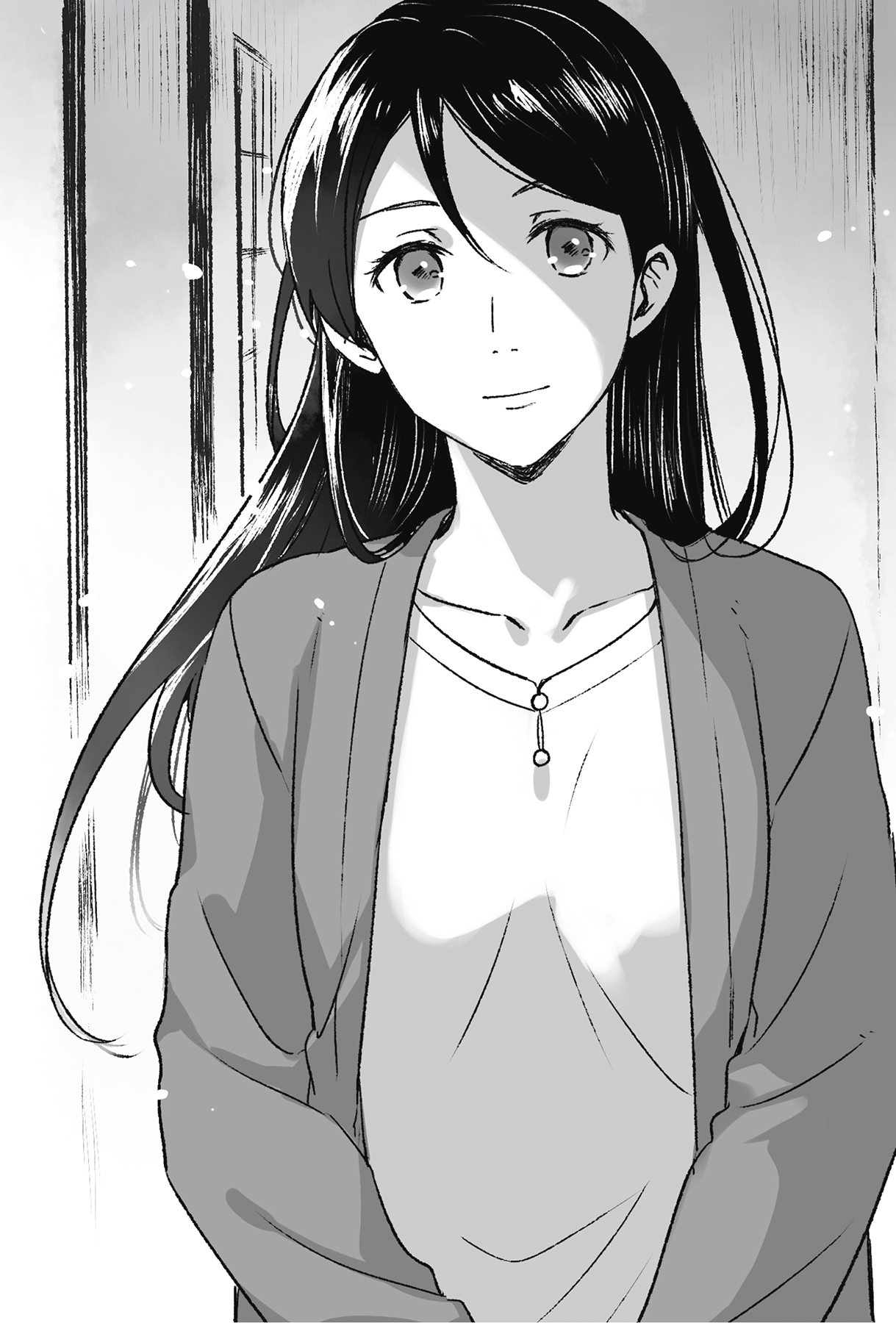
A young woman emerged from the hallway to the left. She probably wasn’t much past twenty. Her hair was long. Her clothes were very plain but elegant: a black skirt, a white blouse, and a long, gray cardigan.
When the woman reached the entryway, she started, then immediately said, “Oh!” and smiled. It was the wide grin of one greeting a close friend she hadn’t seen in a while, to the point that Toshiki turned around for a moment to see whether someone else had come in behind him. The woman gazed at Toshiki with an expression that seemed to say she’d just found something important, something she’d been seeking for a very long time.
What’s going on? he thought just as the woman spoke.
“You’ve come from Kyoto? Are you the researcher?”
“I’m Mizoguchi from the Institute for Research in Humanities. Thank you very much for giving me a little of your time. I really appreciate it.”
“And thank you for your kind greeting. And for your visit. Won’t you come in and wait in that room over there? I’ll go call my mother, the current chief priestess.”
The room she’d indicated was a Western-style space about ten tatami mats in area. The floor was carpeted, and the reception set consisted of sofas and a low table. Both the table and the sofas were covered with pure white cloth. On the wall, there was a clock and a single still life that would likely vanish from memory unless you were actively paying attention to it. The window was the big bay variety, and it had a view out over the wide shrine precincts. Light from outdoors streamed in. Thin, neatly folded lace curtains hung at either side of the window.
Toshiki wasn’t sure whether to sit at the head of the table or the foot, but then he spotted a little plastic card with the words This seat, please at the head. Reassured, he settled into that chair. This shrine was very good at fielding visitors.
Before he’d waited long, the glass-paned sliding door opened.
The young woman from earlier came in first and took up a position by the wall. Right behind her, a woman a bit past sixty entered. She was wearing traditional Japanese dress, and neither her age nor her appearance yet made her seem elderly. She was short, but her back was very straight, and the eyes that watched him from behind her glasses were sharp. The age gap was a little large, but she had to be the younger woman’s mother, and the chief priestess of Miyamizu Shrine.
As soon as the old chief priestess entered the room, she briskly closed the distance between them until she could look down at the seated Toshiki.
“I know you must be busy. Thank you for—”
“Folklore, cultural anthropology, history, or theology?”
Toshiki had begun to stand up, intending to bow, but the chief priestess’s words froze him mid-rise.
“It’s cultural history, but what I do is very close to folklore studies.”
As he answered, Toshiki was still only halfway to his feet. The old chief priestess had been leaning forward, but she straightened and retreated slightly so that she could see him from head to toe. With that, Toshiki was able to lower himself to the sofa again. “I’m studying the ancient beliefs and rituals that persist in rural areas, and I’m currently gathering stories from the elderly residents of Itomori. Your shrine is at the heart of the beliefs in this area, and I wanted very much to speak with one of your priests or priestesses…”
“Scholars don’t know nothin’.”
Words from above interrupted him. For a moment, he didn’t understand what she meant.
“You’re gonna hear a mess of stories from the old folks, scrape ’em all together, and then write all manner of misguided tripe and present it as the truth. Somebody else like you came here before, and nothin’ good came of it. You can’t understand things like these once they’re in words… What a mess.”
Toshiki thought he probably knew the scholar the chief priestess was talking about, who’d been here before. He’d recently read something that individual had written roughly fifteen years before. It was true that the content had been chaotic, but it was what had triggered his interest in Miyamizu Shrine. This meant it might not be a mistake to say he was the same type of person as the other man.
However…
While the chief priestess was fluidly dousing his ambitions, out of the corner of his eye, Toshiki had seen the young woman who stood by the wall bite back a smile for a moment, then avert her face slightly in a struggle to make her expression neutral again.
That momentary suppressed smile had seemed to say, My mother’s stubbornness is a problem, but it’s also dear to me, and I like it. She was charming. Maybe he should have given her a thumbs-up or winked to show her he had no objection.
Toshiki began to speak.
“Well, if you’ll allow me to explain—”
“Ah, I don’t care. I don’t care.”
Her reply was a peremptory rebuff. Was it fair to call this a point-blank refusal?
Dumbfounded, Toshiki searched for the words he needed to say next. For a while, it wasn’t clear whose turn it was to speak.
“Well, I won’t send you home empty-handed.”
As the old chief priestess spoke, she was rubbing her arms inside the sleeves of her kimono.
“I won’t tell you nothin’. However, this one—” She shot a sidelong glance at the young woman who stood next to her. “She says to answer everythin’ if anyone comes to ask questions and have ’em make a record of it. She says times are different now, and that’s good. That ain’t what I think, but she’s the one who’s gonna support this shrine in the future. And so, well, if you have any questions, ask Futaba here.”
The woman, who’d been watching her mother speak, turned to Toshiki.
“I should have introduced us earlier. This”—she indicated her mother with the palm of her hand—“is Hitoha Miyamizu, who acts as chief priestess and is in charge of this shrine. I am her daughter, Futaba Miyamizu, and I handle a variety of duties here. Again, it’s a pleasure to make your acquaintance.”
She bowed politely.
Following her, Toshiki stood up halfway.
“I’m Toshiki Mizoguchi of K. University. Thank you for your kindness…”
He wasn’t sure whether he should offer her his card, and his hand wavered.
“Uh, thank you. For things like this, though, I need to speak to the senior members…”
“This girl knows everythin’ I know.”
Saying this, the old chief priestess set a hand on her daughter’s back. Then she left the room without a backward glance, closing the door behind her. She’d seemed irritated as she went, but the gesture she used to close the door was quiet and elegant.
Toshiki Mizoguchi and Futaba Miyamizu were left alone in the room. Although neither suggested it, they resettled themselves on the sofas so that they faced each other.
“I’m sorry. You may not believe me, but my mother is usually quite sociable.”
The young woman who’d introduced herself as Futaba Miyamizu beamed, and she spoke with laughter in her voice.
“However, when it comes to certain matters, she’s very stubborn.”
“It isn’t an unusual reaction. Besides, I’m accustomed to being refused interviews.”
Toshiki smiled, too, and their warm expressions softened the tense atmosphere. Futaba Miyamizu was perched on the edge of the sofa, her back very straight. She sat with her knees neatly together underneath her skirt.
“What shall we talk about?” she asked.
“What deity is your shrine dedicated to?” asked Toshiki.
“We worship Shitori-no-Kami Takehazuchi-no-Mikoto. We have no auxiliary or subordinate shrines.”
“Are you connected to Katsuragi Shidori-ni-Imasu Ame-no-Hazuchi-no-Mikoto Shrine in Nara Prefecture?”
“Not at all. Not to Omika Shrine, either. There is no exchange between us.”
The brisk answer was pleasant.
As a matter of fact, Toshiki had known what the enshrined deity was beforehand. The objective of his investigation was to discover whether any of the shrines dedicated to Shitori-no-Kami had unique ritual forms and attempt to interpret the thought patterns of the ancient Japanese from them, thus solving a few historical mysteries. To that end, he’d been visiting all the Shitori shrines in Japan.
There were several enigmas surrounding the deity Shitori-no-Kami, who was mentioned only in the Nihon Shoki and the Kogo Shūi. He didn’t appear in the Kojiki.
He was said to be the god who had taught humans the art of loom weaving. According to the Nihon Shoki, when Futsunushi-no-Kami and Takemikazuchi-no-Mikoto, celestial gods of war, had attempted to subjugate the native terrestrial gods, there was one deity that they were completely unable to subdue: Ame-no-Kagaseo, a wicked star god who lived in the heavens. The one who went to the star god in their place and defeated him was said to have been Shitori-no-Kami Takehazuchi-no-Mikoto. How a god of weaving had managed to subdue Ame-no-Kagaseo when a heroic god like Takemikazuchi had failed was a mystery, and although there were various arguments, there was no established explanation.
“How does your shrine speak of its enshrined deity’s exploits?”
“Takehazuchi-no-Mikoto is said to have vanquished a dragon here.”
That was an impressive story, or rather, a sensational one.
“Here, in this area?” Toshiki asked.
“Yes.”
“You consider Ame-no-Kagaseo to have been a dragon?”
“At our shrine, Ame-no-Kagaseo is a dragon. Is he not? Oh, you’re right, I expect he isn’t. In the Nihon Shoki, he’s described as a star deity, after all.”
Interesting.
Or rather, Toshiki felt that he was onto something here. If he followed this lead, he had a hunch that something would turn up. It was likely that this shrine’s legends were completely unique. With these tales as clues, he might be able to unravel one of the myth’s mysteries. Comparing it to the Yamata-no-Orochi tradition was also likely to yield intriguing results.
“How do you think the deity of your shrine conquered the dragon? Do you know the details of the exploit?”
“An explanation hasn’t been handed down, but I personally think he may have braided lots of cords, then caught and bound the dragon with them.”
“With cords?” Toshiki shifted on the sofa, changing his position slightly. “You mean he tangled him in ropes instead of throwing fabric over him or something similar?”
“I think that may have been the case.”
“Why?”
“At this shrine, we braid cords as part of our religious rites. The town of Itomori produces and sells braided cords, but if you follow the practice back to the beginning, I think it started as a shrine ritual and then spread to the people. Even today, we use braided cords in our kaguras, we distribute them to visitors through our presentation booth, and we teach all our parishioners and worshippers how to weave them. We encourage them to put the cords they create on their family altars and wear them.”
“By braided cords, you mean the cords made from different-colored threads woven into complicated patterns?”
“Yes, I think what you’re imagining is correct.”
“Why not fabric, I wonder? I’ve never heard of any other Shitori-worshipping shrines that braid cords. Even if I searched all the other Shitori shrines in the country, I think this would be the only one. Your shrine is unique. Why do you weave cords here, instead of cloth?”
“I don’t know.”
“Is there a record of roughly when you began braiding cords?”
“I don’t know. Um, this is embarrassing, but we know almost nothing about that sort of thing.”
“Huh?”
“They say it was in the third year of the Kyouwa era, so it would have been in 1803, more than two centuries ago. A fire broke out at a straw sandal–maker’s house near the shrine, and it turned into a wildfire. The village of Itomori sustained great damage, and Miyamizu Shrine was reduced to ashes. Many members of the Miyamizu family who had worked as priests and priestesses died at once. They seem to have kept records on paper, but those all burned. The incident is known as The Great Mayugorou Fire, after the owner of the sandal shop.”
They’d named it after the person responsible for the outbreak? The tale was rather tragic on that front, too…
“That’s a shame. It’s a real loss for the history of Japan as well.”
“Yes, truly. I think so myself. As a result, our recorded history breaks off two hundred years ago. The shrine was shifted slightly from its previous location, and its scale is smaller now.”
“They used ‘sole heir’ succession then, didn’t they?”
“That’s right. I think most shrines were like that, long ago. It’s different now.”
I see. If a thing like that happened, you certainly would lose those memories.
Long ago, shrines had often taught the ritual procedures for their ancient services and the Shinto prayers specific to that shrine (or the structural rules dictating their content) to a single heir. Since everything was handed down to just one child, it was known as “sole heir” succession.
Why had they done it that way? There were several reasons. They’d probably intended to prevent their expertise from leaking and producing competing shrines. If there was an important rite that only one particular clan could do, it would be impossible to damage the clan. The task would serve as a defense against those in power.
However, at the same time, this form of succession had serious drawbacks. If, for whatever reason, the traditions were not passed down, all the secrets they had protected since antiquity would be lost.
This would be the case if the previous heir died suddenly before the secret rituals could be handed down, or if, as had happened at Miyamizu Shrine, both the previous heir and the next heir died in an accident. All memories of the past would be lost, and continuity with the shrine’s prior self would be broken.
In the space of ten or fifteen centuries, accidents like these had probably occurred over and over. Every time, no doubt the chain had been interrupted, and the forms of the ancient rituals had fragmented, crumbling away.
Historians said that Shinto had assumed its present shape near the beginning of the Heian era. Whoever had set the sole heir succession rule, either at that time or earlier, probably hadn’t imagined that their rituals would persist as tradition one thousand years later. It was understandable, but even so, Toshiki wanted to begrudge those fictitious persons.
Each and every shrine in the nation must have had their own unique prayer formats and rituals.
However, in the present day, almost none remained. Most of the prayer structures and ritual procedures at modern shrines had been redeveloped in medieval or early modern times. In that sense, unlike Buddhism—most of whose scriptures had been recorded in writing and remained to this day—one could say that Shinto was a religion that had lost its link to the past.
“One thing makes more sense to me now,” said Toshiki. “Earlier, there was a worshiper reciting a prayer on the shrine grounds that sounded as if it belonged to the Izumo system.”
“Yes, several of our shrine’s current petitions—we call our prayers ‘petitions’ here—are the same as Izumo Taisha’s.”
“After the great fire, I guess they had to use something as a reference in order to recreate their lost prayers, and they borrowed them from Izumo. But Shitori is a celestial deity. As part of the celestial deity system, why would your shrine have used prayers from a terrestrial system?”
“That’s a good question. I think people at the time must have been very broad-minded. I find it charming…” A gentle smile found its way onto Futaba Miyamizu’s lips. “Among the ancient documents that burned, I expect there were explanatory notes and model sentences for petitions that praised the god Shitori’s exploit in vanquishing the dragon. I often think of what might have been if things like that had remained, too.”
Although he didn’t hold out much hope, Toshiki made a suggestion. “Would it be possible to extract the distinguishing characteristics from the prayers that weren’t lost and reconstruct the general progression of the ones that were?”
“Would you be willing to do that yourself? If it’s all right to ask, of course.”
Futaba Miyamizu was looking directly into Toshiki’s eyes.
“I have the prayers written down. Shall I copy them and send them to you? Immediately after the fire, one of the surviving priests wrote down everything he remembered. Are you able to receive e-mails?”
“Yes.”
“I have text files, so I’ll send those to you.”
“That would be wonderful. Thank you very much.”
“No, no. We’re afraid of losing things, too, so we’d like a variety of people to have them.”
Toshiki’s eyes widened slightly.
He’d met countless shrine workers in previous interviews, but she was the first one who’d ever said anything so openly.
Toshiki was aware that his interest was beginning to turn toward the personality of the woman in front of him. Although it would stray from the etiquette of academic interviews, he started wanting to ask questions that were slightly more forward.
“Erm… In reality, dragons don’t exist, correct?”
“No, not to my knowledge. I think ‘dragon’ must have been a metaphor for something else.”
“If we can clarify what the origin of that metaphor was, we will have solved one historic mystery. At the very least, it will be a vital key. It’s my business to think about that kind of thing. Can you give me any suggestions regarding potential clues?”
“I’m not an expert in that, so I…”
“No, on the contrary, I want the opinion of someone outside of these studies. You’ve lived in close contact with the traditions of this shrine. Even if the records are lost, you must have inherited the context that runs through those customs,” Toshiki said.
Futaba Miyamizu set her hands on her knees and shifted her feet.
“Let’s see… This is just an example, but perhaps it was a tyrannical ruler. Maybe an invader or conqueror. I wonder if there was something like that and the people expelled it by working in close cooperation.”
The tyrant was the dragon. The people who’d cooperated would be—
Toshiki speculated, “So you feel that the loom weaving and braided cords are an expression of the wills, as the people formed a cooperative network?”
Futaba Miyamizu nodded.
The idea seemed rather tame, but it was a new theory.
Toshiki laced his fingers together on his knee and considered. As he sat silently, deep in thought, Futaba Miyamizu spoke with some amusement.
“You seem unconvinced.”
“No, that isn’t…”
He tried to evade her, but Futaba Miyamizu was smiling slightly in an expression that said, Are you sure about that? Giving up, Toshiki admitted it was true.
Futaba Miyamizu brushed the hair that had coiled around her left shoulder away with her right hand and faced Toshiki again.
“Would you tell me what you’re thinking right now?”
Her voice was beautiful, soft.
This is bad.
Toshiki Mizoguchi’s face tensed.
The phrase “I want to hear about you” was a coup de grâce.
Most researchers were starved for those words.
He was no exception.
However, during interviews, interviewers weren’t allowed to reveal much about their own interpretations. If they did, any conversation that followed would be biased.
In an attempt to make the interviewer happy, the subject would relate only anecdotes that meshed well with that interpretation or unconsciously warp the original story.
Toshiki explained this, but Futaba Miyamizu tilted her head ever so slightly and said, “That may be true, but I want to hear what you have to say.”
That wasn’t just a verbal deathblow.
She’d practically killed him, period.
“The priest at your shrine two centuries ago saw nothing strange in introducing prayers from the Izumo system. In fact, it may even have felt right to him. I think that may be an important clue. It’s conceivable that the context of your shrine’s beliefs was sympathetic toward the terrestrial system. Izumo is the general superintendent of the earthly deities. However…”
Toshiki succumbed to the desire to express his thoughts and put them into words.
“Shitori-no-Kami Takehazuchi-no-Mikoto is part of the celestial deity system, so at first glance, it seems like a contradiction for Miyamizu Shrine, which worships Shitori, to have sympathy for the Izumo system. However, if we take Ame-no-Kagaseo—who is paired with Shitori-no-Kami here—into consideration, the situation changes. Since Ame-no-Kagaseo is a star deity, he’s seen as part of the celestial system; however, since he was a rebellious god who refused to submit, his personality was similar to the terrestrial deities. In short, it made me think that originally, Miyamizu Shrine may have been a star shrine that venerated Ame-no-Kagaseo.”
The woman who served as a shrine maiden at Miyamizu Shrine leaned forward slightly. Her posture urged him to continue.
“This morning, I went to the prefectural office and did some research on Itomori. They say that Itomori Lake was created by a meteorite strike.”
“Yes, that’s true,” the woman said.
“The ancient word for snake is kagashi. That’s the kagashi in yamakagashi, the ringed grass snake. There is a theory that Kagaseo is a corruption of kagashi, and that Ame-no-Kagaseo was a heavenly snake and received the name when people likened a shooting star to a snake. Snakes are associated with dragons. That’s how Ame-no-Kagaseo can be both a star deity and a dragon. The braided cords may originally have symbolized snakes. That would explain why Miyamizu Shrine weaves cords instead of cloth.”
Futaba Miyamizu nodded. This was marvelous.
“Then a meteorite fell,” Toshiki Mizoguchi said. “From what I hear, it isn’t clear just when the meteorite strike took place, but a star fell on a village that worshipped a star deity. A host of people died. Death and destruction are impure. People who worshipped a star had been defiled by a star, and so it may have seemed as if their god had betrayed them. In order to cleanse themselves of that impurity, they may have switched to a different object of worship. Veneration of Ame-no-Kagaseo was abandoned, and the worship of Shitori-no-Kami, his natural enemy, was introduced. The cords representing snakes were reinterpreted as bindings around the snake. So I was just thinking that if we took all the information that’s been discussed today and restructured the story, this is what we’d end up with. I’ll take your questions now,” he finished, speaking like a lecturer.
Miyamizu chuckled silently. Then she said, “Originally, there was a shrine to Kagaseo that worshipped a shooting star and wove cords as part of its rituals. A meteorite fell and destroyed the village, and as a result, they discarded that religion and introduced the worship of Shitori-no-Kami, since he could subdue stars. The custom of braiding cords gelled with the worship of Shitori-no-Kami as well, so it was left unchanged.”
That was exactly what he’d wanted to say. The young woman had understood it completely, and this satisfied Toshiki.
Futaba Miyamizu lowered her eyes and quietly reflected. Toshiki Mizoguchi spent that interval observing her long eyelashes. Those eyelashes formed eaves, to the point where he could nearly see their shadows in her eyes. At last, the woman raised her head.
“You’ve done a good job of incorporating and coordinating the existing information. As a theory, I think it holds together.”
Still watching Toshiki, the shrine maiden touched a fingernail with her fingertip.
“However… It seems oriented in a different direction from my instincts as one who is in contact with the ways of the Miyamizu. In our activities, I don’t think it matters all that much whether the resulting product is cloth or cords. Instead, the emphasis is placed on braiding and weaving. That would mean that since antiquity, since before the meteorite, weaving was our religion, and we had a ritual format in which our woven products were offered before the altar, and so…”
In other words, they’d always worshipped a god of weaving?
This was fun.
Truly gratifying.
He felt dangerously prepared to open up to her.
“Do you have any grounds for your argument?” Toshiki asked. “Anything that would reinforce that theory, I mean.”
“Intuition.”
Futaba Miyamizu spoke frankly, with no inhibition of any kind. Her next words were graced with a very pretty smile.
“It is intuition, but the instincts of the Miyamizu family are nothing to sneeze at.”
After that, Toshiki Mizoguchi and Futaba Miyamizu continued their discussion for a long time. When the conversation returned to the question of what exactly the dragon metaphor represented, Toshiki abruptly glanced out the bay window behind him. Itomori Lake wasn’t visible from there, but he tried to see it with his heart anyway.
“I wonder if that means the dragon’s still living in the lake,” he remarked as if he were talking to himself.
“It might turn into a famous tourist attraction, like Nessie from Loch Ness,” Futaba Miyamizu said candidly. “This is Itomori Lake, so…”
“Itosshi, maybe?”
“It sounds like itoshii, ‘beloved.’ How funny.”
They both laughed.
As he left, Futaba Miyamizu was all smiles in the entryway.
“Do come again.”
“Huh?”
“You will come again, won’t you?”
“Yes, probably,” Toshiki answered honestly. Afterward, he asked a question he’d had on his mind from the very beginning. “When I first arrived, you looked at me, and you seemed startled. After that, you smiled softly at me. What was that for?”
Though still beaming, Futaba Miyamizu looked faintly troubled…
…and replied with an astounding answer.
“I don’t know the reason, but when I first met you, I felt as if I would marry you. I wonder why. It’s curious, isn’t it?”
After saying such a thing as if it was nothing, Futaba Miyamizu realized exactly what it was she’d said.
“Oh, I…” She put her hands to her cheeks and averted her face. “That’s strange, isn’t it? It’s… Is it strange?”
3
After that, he met Futaba Miyamizu many times. During those encounters, Toshiki firmly reminded himself that these were fieldwork interviews.
He was deeply interested in the kagura dances that had been passed down through the Miyamizu family. From what he’d heard, even with The Great Mayugorou Fire, the Miyamizu kaguras were almost completely intact to this day. Since dances took a lot of time to learn, they had been taught to many women at once, starting very early on. Some kagura were meant to be performed by a group of many dancers, so village girls had studied them as well. As a result, these dances had apparently been easy to recover and re-create. However, even before the great fire, they’d lost sight of what the kaguras actually portrayed.
While they were on the topic, Futaba Miyamizu asked, “Shall I show you?”
“What?”
“Shall I show you a kagura dance now?” As she said it, Futaba Miyamizu was already halfway out of her chair. “Come to the kagura hall. The lattices are all the way down, so it will be a bit dark, but…”
He didn’t often get the chance to see the interior of a kagura hall on an ordinary day, when there was no festival in progress. The walls on three sides would be opened wide during an actual performance, but now they were closed, and the only illumination came from the dim orange light bulbs on the ceiling. Their light resembled the color of twilight. In this square, windowless space with its single small entrance, the term sealed room surfaced in his mind.
Futaba Miyamizu entered that sealed room, and then they were alone.
She held some golden bells decorated with braided cords and attached to a handle; she’d brought them from the hall of worship.
“May I record this?” Toshiki asked, taking out his digital camera.
“Yes, go ahead.”
He still played that recording every now and then.
When Toshiki thought of Futaba Miyamizu, the first thing that came to mind was white.
There always seemed to be a very faint white light around her, but this was an illusion, of course. It’s just that she always wore the color somewhere on her person. As a result, the image of whiteness had made a deep impression on him.
That had to be the case, but when he closed his eyes, he felt as if there was a source of light in the midst of the darkness that showed him where she was.
Not good…
Toshiki Mizoguchi had believed that his heart was immovable.
He could be as amiable as required in any given situation, but it was all an act.
He fundamentally did not care about forming connections with other people.
This had never struck him as an inconvenience, and living that way had been easy.
His childish defenses were being torn down. Just meeting her was enough to make them crumble without resistance.
The obstacles he’d built were giving way.
He’d always told himself that these were work interviews.
Then the moment came when this self-persuasion no longer worked. Toshiki’s intentions underwent a reversal. It was a strange sensation to know that his own will was falling in the very direction of an idea it had refused to consider. It was like tumbling backward off a cliff.
In the midst of that free fall, Toshiki was sure multiple obstacles would arise from this point forward, and he would probably have to pay a heavy price.
He was likely to lose nearly everything he’d built for himself so far.
But that was just fine.
It was trivial compared to what he would be gaining.
Toshiki Mizoguchi finally gave up.
I suppose I really am going to marry this woman.
When Toshiki told Futaba about this, they were on the shore of Itomori Lake. Futaba took Toshiki’s hands, leaned into him for a hug, and kissed him on the neck. Her build was far smaller than Toshiki had guessed. This was unexpected, possibly because she had come to occupy such a large part of his heart.
On the surface of the lake, sunlight glanced and sparkled off the waves the wind kicked up. That wind blew across the lake, teasing them pleasantly. They could virtually smell the scent of the green mountains all the way down here. Everything around them was marvelous, but the couple’s faces were still tense. They were contemplating the things they might lose from now on, as well as the things they were certain to lose.
Futaba’s mother—Hitoha Miyamizu, the chief priestess of Miyamizu Shrine—had opposed the marriage with glaring displeasure. Since her only daughter had said she was going to marry a man she’d met just recently, this could be considered a natural reaction; however, her daughter’s refusal to respond to persuasion or scolding alarmed her badly. Their values had never seriously deviated from each other before.
Futaba stubbornly refused to back down, insisting that she was absolutely getting married, no matter what. She wouldn’t give an inch, confounding her mother time and time again during their discussions.
These spine-chillingly tough negotiations between mother and daughter went on for several days. Toshiki wasn’t able to get a word in. If he tried, it only would have complicated matters. This was something Futaba would have to get through on her own, however she could.
Hitoha Miyamizu was genuinely resistant to introducing the blood of someone she didn’t really know into the Miyamizu family, but finally, she was worn down.
The overall sense was that victory had gone to the one with more stamina, but at least in part, calming down and gaining a better understanding of the situation might have been what caused her to surrender, in the end. The Miyamizu chief priestess grumbled that all the work she’d poured into carefully selecting bridegroom candidates had been in vain.
However, Hitoha Miyamizu set some conditions for Toshiki. She would condone their marriage, and in exchange, he would be formally adopted into the Miyamizu family. He would quit his current job and work for Miyamizu Shrine. Futaba tried to get her to withdraw these conditions as well, but it wasn’t possible to make her mother cede that much.
Quit his job? Be adopted? Perfect. Bring it on. Toshiki accepted the conditions easily: “That’s fine.” After all, things would have ended up that way in any case.
The Mizoguchis were an old family from Nara. Toshiki was the oldest son. His parents were landowners, and although Toshiki currently lived in an apartment in Kyoto because of his work at the university, his family and relatives took it for granted that he’d come back home someday. In addition, near that home, he had a fiancée who had been chosen for him by their respective families.
He’d had no particular interest in marriage, so although he’d known his family was working on something to that effect, he’d left the matter alone. Before he knew it, the people around him had advanced matters past the point of refusal. Not only that, but his fiancée was the granddaughter of a work colleague and former professor of his, although that was partly by chance.
There were long, long discussions in multiple places. Toshiki explained the situation very ardently, but on the surface, he seemed perfectly calm. That tranquility infuriated the others even more. They were angry, and angry people want the other party to react with equal ferocity in order to escape the intrinsic ugliness of having that emotion. When that unconscious expectation is betrayed, they feel as if their own spite is being pointed out to them and grow even more furious. It’s a vicious cycle.
With this analysis in his mind, Toshiki simply kept explaining. The negotiations constantly looped back, and he fielded the same questions over and over with the same answers. At no point did he show any strong emotion. He didn’t feel it was necessary. He was insulted again and again, but he did not become angry. No matter how the others criticized his character, Toshiki didn’t think it affected his worth. As they went around in circles, and Toshiki patiently stuck with this discussion—which couldn’t rightly be called a debate—he adamantly refused to yield anything past a certain point. There were threats and entreaties. There were manipulative tears, intimidation, and persuasion. There were barbs and silence. He watched them all appear and vanish, randomly, kaleidoscopically.
None of them moved his heart.
Not a single thing about these people could affect him.
He hadn’t meant to, but as a result of this process, he’d been able to assure himself of that.
It was wonderful.
He’d found something that wasn’t like these others.
He’d found something that could move him, and before long, it would be his.
Such was the backward conclusion he reached.
It was as if, in some twisted way, he was fortunate.
A paradoxical blessing.
At home, the familiar line ultimately made its appearance—“Get out, and never darken our doors again”—and from that point on, with the exception of funerals, it was decided that they would have nothing to do with one another. This didn’t particularly bother him.
He left the university as well. At the time, research laboratories at old universities still had an apprentice system (especially in his field), and it would have been difficult for him to continue working there after his former professor and his granddaughter lost face because of him. However, this didn’t upset him much, either. In Toshiki’s field, even if he wasn’t at a university, he could continue his research without much difficulty.
Left with nowhere to return to, Toshiki Mizoguchi moved into the Miyamizu residence beside the shrine in Itomori and became Toshiki Miyamizu. From his old place, he brought a Technics record player, a Marantz amp, Tannoy speakers, and exactly one hundred LP records (thirty-five of which were Glenn Gould), plus clothes, a Pelikan fountain pen, and an old computer. He had too many books to move, so he donated them to the university. He asked a friend for a huge favor: adopting his cat.
As he was sitting in a wooden folding chair on the tatami, organizing his belongings, Futaba came in.
“Dear.”
That was what she called him, even before they were legally married. Being called Dear was a novel experience.
It was hard to look at Futaba’s expression. It said she felt sorry for Toshiki and that she felt intense pain for him. The sight hurt Toshiki, too.
He wanted to touch those long eyelashes with a fingertip.
“It’s fine.”
He pulled Futaba close and set a hand on her waist.
“If I have you, I don’t need anything else.”
He’d meant the words literally, but when he abruptly grasped what he’d said, he realized you really couldn’t say a line like that unless you were drunk.
He thought she might laugh at him, but she accepted the comment seriously, despite his being sober.
“Thank you…”
And so they became husband and wife.
4
Although Futaba’s mother didn’t appear to be completely satisfied for a while, in the end, she accepted Toshiki.
When that happened, matters progressed very rapidly on the Itomori side.
They didn’t hold a reception. However, naturally, they had a Shinto ceremony. As was to be expected, Hitoha Miyamizu took charge of everything.
Since it was a long way, and because the local transportation infrastructure wasn’t developed, only five of the personal friends Toshiki had called managed to make it to Itomori. It was impressive that those five had come at all. Meanwhile, on the bride’s side, so many people attended one might have thought every member of every household in town had shown up.
This was already a sign.
“Someday, you need to learn to do what my mother’s just done, all right? We’ll teach you.”
“…You mean act as chief priest at a Shinto wedding?”
“That’s right. Weddings look best with a male priest. My late father used to do it, too.”
“Your father must have had it rough.”
Toshiki’s answer was easygoing, but inwardly, he thought, This could get hairy.
Priests’ behavior was governed by incredibly detailed customs. There were set ways to do everything, from expressing thanks and handling the ritual baton to putting the correct foot forward first and moving his fingertips just right.
Naturally, he’d known that much, and he’d expected that he would probably end up learning these things himself, but he’d never dreamed they’d expect him to become competent enough to officiate at weddings.
The first day Toshiki went to work at the shrine, his mother-in-law, who’d come after him, said, “Ask Futaba for everythin’.”
Although she was obviously doubting whether he would amount to anything, she hadn’t tossed the suggestion at him carelessly.
“Futaba is more a Miyamizu than me or anyone else. You can’t go wrong by askin’ her.”
This was before his mother-in-law’s health was failing and her personality weakened. Toshiki still didn’t really understand what it meant to be a Miyamizu.
He wasn’t sure that he could call it “training,” but his studies to become a priest began. He started by learning how to put on, take off, and fold his blue hakama and white kariginu cloak, followed by how to bow, how to handle the implements, how to think… And Futaba taught Toshiki all of it.
Miyamizu Shrine wasn’t affiliated with the Association of Shinto Shrines, and since everything progressed far differently from other shrines, he was never instructed to go take classes for would-be priests or to study at Kokugakuin University.
However, that probably would have been easier.
These teaching methods are just…
Because he was family, they held nothing back.
He lived with his teacher at all times, morning and night. Possibly because he was never able to relax, Toshiki felt himself rapidly transforming into a Shinto priest. It was almost as if he could hear each piece of himself reorganizing and clicking into place.
Prayers were the one thing that gave him almost no trouble. Due to his former line of work, he was able to read and write in the ancient language. On that point alone, he was at ease. However, if he called them “prayers,” he was corrected: “They’re petitions.”
By the time he was accustomed to life in Itomori and at Miyamizu Shrine, he slowly began to understand something that gradually surprised him more and more.
Futaba Miyamizu held uncommon influence in the town of Itomori.
Futaba, who was now Toshiki’s wife, wasn’t yet twenty-five. However, even if Toshiki—who was a full twelve years her senior—was sometimes treated like a youngster, he’d never seen anyone treat Futaba like a little girl.
The way they approached her was quite the opposite.
By any ordinary measure, Futaba was barely out of girlhood, but in this village, she was terribly respected.
From what Toshiki’s quiet observations told him, it was almost as if Futaba’s body radiated some mysterious aura visible to none but the residents of Itomori. The old people in particular seemed to view her as an actual object of worship. Hitoha was respected as well, but not as much as Futaba.
He’d learned this before, from his interviews with elderly residents back when he made visits to Itomori for research purposes, but historically, Miyamizu Shrine had been recognized for its powerful family in the area as well as being the center of worship. There had been a time when the Miyamizu women issued unilateral orders, and the villagers were completely unable to disobey.
After the war, the social order changed dramatically and swept away that atmosphere, but some of the elderly residents still held on to the past.
It was possible that Futaba’s unique, otherworldly aura awakened memories of the old system of rule in the depths of their minds.
One ninety-year-old he’d interviewed had told him that “the gods seem to dwell in Miss Futaba.”
He still had the recording from back then.
Possibly because of the subject’s age, the audio was a bit mumbly, but it went something like this:
“Me, y’see, I’m one o’ those, one o’ Miyamizu’s parishioners. My ancestors, too, fer generations.
“That means I’ve known their people (note: referring to the Miyamizu family) fer ages an’ ages.
“Miss Toyoko an’ Miss Setsuko an’ Miss Kotoko an’ Miss Kotoha an’ Miss Hitoha an’ Miss Futaba. I’ve watched ’em all this time.
“Well, I only saw Miss Toyoko a li’l bit at a festival when I was a tiny thing. I’ve known Miss Kotoha real well, though. We was in the same grade, y’see.
“But Miss Futaba, now—that girl’s real good.
“Oops. I can’t call her ‘that girl.’ The young lady’s real good. She’s light itself, she is.
“I can’t say I know fer sure, but it feels like the gods are there inside her.
“I mean, she’s a beauty, but it ain’t just that.
“We’ve got a family altar at my place, too, an’ we hold services, but y’know, it ain’t much more than a custom.
“When I look at Miss Futaba, though, I start thinkin’ it might be all right to believe in the gods.
“I wonder why. It ain’t logical or nothin’, not with that girl— Ah, I can’t call her ‘that girl.’”
Possibly because the residents thought this way, whenever the townspeople were conflicted or worried about something, they brought the problem to Futaba. Any opinion she gave them was held in very high regard.
The things they came to discuss made Toshiki a bit cynical.
Matters like relationship trouble or the listlessness that comes with aging were ordinary, but their universal nature made them especially compelling. Those he could understand.
I’m feeling pain in my joints, and I’d like to go to a hospital. Which would be better, Hospital A or Hospital B?
Our cow doesn’t have any energy. What should we do?
He’d think, Ask an expert, ask a fortune-teller, or go draw a fortune slip.
What era is this, anyway?
The institutional village custom of having a wise old person to discuss problems with had persisted to the Taishō era at most, and had probably died out by the Shōwa era.
It was just like the Edo era in a comic story, with the side-street retiree, et cetera.
This surprised Toshiki, but what surprised him more was that the advice Futaba gave them was organized and accurate.
She’d give the sort of explanation that would make him slap his knee and think, Why didn’t I think of putting it that way? and state her conclusion, and that conclusion would be correct.
To Toshiki, it was as if she had a book containing accurate answers to all the questions in the world and the ability to refer to it at any time.
Futaba had told him that these requests for advice had started coming in right around when she graduated from high school.
Toshiki had asked her where in the world she’d acquired the ability to give appropriate answers to questions like these, but apparently, Futaba hadn’t picked it up at any particular time or place, and she didn’t know, either.
One night, Toshiki was in the Japanese room in an outbuilding, which he used as his study. The Miyamizu residence had rooms to spare, and he could use as many as he liked.
The only lamp he’d turned on was the incandescent reading light, and he was leaning back in a low chair with short legs, listening to a Mozart piano sonata and reading a study on Shinto prayers from the Engi-shiki (a collection of examples from the Heian imperial court) when the sliding door opened quietly. Futaba walked in.
Wordlessly entering the air filled with piano music, Futaba reached down and hugged him. Apparently, she’d gotten lonely.
She sat on Toshiki’s knees and hugged his head to her.
Toshiki set down his book on the tatami, put his arms around her, and gently stroked her back.
The texture of her blouse was nice. His fingers felt her body through the blouse, and the sensation of the fine fabric rubbing against her smooth skin was pleasant, too. Toshiki buried his face in her softness and tried to listen to her heart.
What had Futaba done when she felt this way before?
She must have had crowds of friends.
However, she probably wouldn’t have been able to find someone she could hug when she got lonely in Itomori.
Futaba shifted position, slipping an arm around his neck so she could bite his earlobe. She seemed to really like ears. When her lips touched him, a gentle rustling sound tickled his eardrum.
She might have been trying to tell him something that couldn’t be put into words.
5
“Everythin’ in the world ends up where it should be.”
In the morning, as Toshiki prepared the food and drink offerings and presented them before the altar, he sensed something strange as he was doing this.
He was becoming a rather admirable Shinto priest in some respects—his physical motions, his head, and his lips that could recite petitions fluently—but his mind still hadn’t gotten there.
When Toshiki returned to the house that night, Futaba, who was refraining from her work at the shrine for a while, was sitting in the traditional room and folding laundry in a leisurely way. As he helped her out, Toshiki talked about unimportant things that didn’t require any particular conclusion. In the course of that conversation, when Toshiki murmured, “It still feels strange to be here in the Miyamizu house doing things like this,” Futaba replied that everything in the world ended up where it should be, and that this was true for him as well.
What amazing things she said. It was like a divine revelation.
She seemed to be implying that there was some meaning in the fact that Toshiki had come to this town and stayed with this family.
“There’s meanin’ in this child’s birth here as well.”
Futaba touched her belly, which was growing steadily bigger. She lowered her eyes, completely at ease, then took Toshiki’s hand and set it against her stomach.
Toshiki didn’t believe there was any particular meaning in his birth. He’d had no say in whether he was born or not, but afterward, he’d lived by his own will and his own choices. It felt odd to be a priest here in Itomori, but he didn’t think he was here through anything other than his own resolve. His choices determined his self, and he existed due to the choices he’d made. Toshiki’s philosophy was like an existentialist’s.
Furthermore, he didn’t feel that he’d been born in order to bring this child into existence. That perspective diluted the nobility of free will. He’d chosen to get married, he’d chosen to come live here, and this was true of creating a child as well.
Even so, when Toshiki thought, I’m half responsible for the existence of a new person, someone who’s going to come into being soon, an unknown sensation washed over him.
To provide a visual metaphor, it was like gazing down a tunnel of time and seeing the universe at its end.
Something connected and unbroken.
For Futaba’s first delivery, the contractions started a good while before they were due. At the time, Toshiki was at a hotel in Aomori Prefecture for a cultural anthropology workshop. While he was faking smiles at a post-meeting “get-together” held for reasons unknown, his cell phone buzzed. It was a text from Futaba.
It looks like the baby’s on its way, so I’m going for a little ambulance ride.
That’s an incredibly laid-back text, he thought, and then he went pale as his mind grasped the situation.
He couldn’t get an airline ticket. He had leaped onto the Tohoku Shinkansen, but a storm stopped it. In Tokyo, he missed the last Tokaido Shinkansen, so he rented a car. He headed west on the Tokyo-Nagoya Expressway, nonstop, and it felt like an eternity to get through Aichi Prefecture and reach Z. County in Gifu Prefecture, where Itomori was located. He drove up to the general hospital and tried to dash in through the front entrance, but it was after hours, and the locked automatic doors barred his way. He raced in through the back.
When he opened the heavy sliding door of the hospital room, Futaba was in the bed. Next to the bed sat an incubator, and the baby was in it.
For a short while, Toshiki stood where he was, gazing at the square, cream-colored room and what lay in its center. It felt as if something warm was radiating from the heart of the room out to its edges, and it had touched him the moment he opened the door, enveloping him from head to toe.
He approached. Futaba was awake but exhausted.
“How…was it?” he asked.
“It startled me.”
In spite of himself, Toshiki laughed a little. Her impression of childbirth was that it “startled her.”
Futaba held a hand out to him, so he took it. Still holding her hand, he peeked into the incubator.
The thing inside looked fresh and almost wet. It was covered in wrinkles and flushed red.
Not to state the obvious, but babies were so red.
Toshiki reached out his little finger and touched the baby’s tiny, still-weak hand. It seemed as if he might break her if he picked her up with his adult male hands, so for now, all he could do was touch her.
It was curious.
This baby, who didn’t even really look human yet, was bound to be the spitting image of Futaba soon.
This wasn’t a wish or even a prediction. He knew it as solid fact. The certainty was very strange.
“Dear, her name…,” Futaba said.
They’d known ahead of time that they were having a girl. Because of that, they’d written down dozens of girls’ names and erased them, over and over. Even today, there were still ten candidates remaining. But…
“Mitsuha.”
It wasn’t any of the names they’d considered before.
A little surprised, Futaba tilted her head. Really?
“It’s the only name there could possibly be.”
His wife’s name meant “two leaves.” He didn’t know or care about the Miyamizu family, but this child was Futaba’s other half. For that reason, she’d have the name that came after Futaba’s: “three leaves.” Mitsuha. He could think of nothing else.
“I wonder why…,” Futaba said. “When she was born, I thought that might be the only name for her, too.”
When Mitsuha’s tiny hand, which he’d hesitated even to touch, grasped the finger he held out to her, she’d caught his heart. Even now, Toshiki remembered that moment vividly.
Mitsuha was a very docile child and easy to care for.
Until she was around five years old, her face didn’t resemble Futaba’s as Toshiki had assumed it would, but right before she began elementary school, she began to exude the same atmosphere as her mother.
“But she’s exactly like you, too, Dear.”
“Is she? I don’t know about that.”
“Her stubbornness is just like you.”
That evaluation didn’t match Toshiki’s.
“Is Mitsuha stubborn?” he asked.
“Very.”
If there was one thing that concerned him, it was that Mitsuha didn’t seem to smile as much as other children. However, once he gave it some thought, Toshiki realized he didn’t smile much, either; he’d been that way since he was a boy. In other words, she took after her father.
Mitsuha grew very attached to her unsociable father. One holiday, when Toshiki was on the veranda basking in the sun and reading the scholar Yanagita’s works, Mitsuha trotted up behind him with light footsteps. She was holding a picture book and called to him from behind his back. “Daddy.”
He thought she wanted him to read to her, but he was wrong. Mitsuha plopped down on her bottom in front of Toshiki and sternly opened her book. He watched her for a little while, but she seemed to be completely absorbed in it, so Toshiki let his eyes return to his own.
On the boards of the long, sunny veranda, father and small daughter sat facing each other, each reading. Futaba saw them, laughed, and called Hitoha to show her. “Mother, Mother, over here, come here.”
Even Hitoha laughed with a “My, my.”
So far, he hadn’t seen a flicker of Futaba’s unique brilliance in Mitsuha. Toshiki felt, from the bottom of his heart, that this was a good thing. It was clear from Futaba’s example that if Mitsuha was filled with the same unique intelligence, the people around her wouldn’t let her leave Itomori. If possible, he wanted to send her to a university, give her the opportunity to find a job and experience the outside world, and let her settle into a career she liked.
A little while after Mitsuha started elementary school, their second daughter, Yotsuha, was born. Again, the birth happened well before the due date, and on that day, Toshiki was in Okayama. Of the people who’d been born and raised in Itomori and had moved away, there were some with a strong wish for the construction site of their future home to be purified by a priest from Miyamizu Shrine.
This time, he made it in time for the delivery. He spent the whole time pacing up and down the hall in front of the delivery room with Hitoha.
The heavy resin sliding door separating the delivery room from the corridor opened, and he rushed inside. As on the other occasion, before he saw the baby, a deep emotion he wasn’t able to name washed around him in a flood.
Toshiki didn’t know what it was for a very long time. Afterward, he understood that feeling was the tremble of his heart because the world now held yet another person who was more precious to him than himself.
Good grief. The world is full of mysteries.
Up until yesterday, this child didn’t exist.
Now she does.
This still-wrinkly baby would probably grow to be like Futaba as well someday. That was a curious thing, and the fact that he was already clearly convinced of it was just as curious. They’d checked the baby’s gender in advance, but even before that, he’d had a premonition that they were having a girl. That was mysterious, too.
“What should we name her?” Toshiki asked.
Futaba was lying back limply, but she was smiling. “If it isn’t Yotsuha, either Mitsuha or this little one will probably be mad at us later on.”
“Which one do you think will get mad?”
“Both?”
6
“All right, now I’ll teach you how to peel taro roots. You’ll be usin’ a knife, so be extra careful, okay? If somethin’ feels dangerous, let go right away.”
In the kitchen, Mitsuha nodded solemnly in response to Futaba. She was wearing gloves and an apron made of thick white fabric. A cutting board and a little fruit knife apparently made for children sat on the kitchen table.
Toshiki was cuddling one-year-old Yotsuha and reading a collection of folk songs from Gifu Prefecture with his other hand. He voiced an opinion that Mitsuha might still be a little young to use kitchen knives, but…
“I researched the safest way for children to peel things.” Looking proud of herself, Futaba replied, “I want to teach these two all sorts of things as soon as possible.”
At the time, he took the words at face value.
Mitsuha was peeling the skin off a root on the cutting board as her mother had shown her, her face set in concentration. Without taking her eyes off the vegetable, she said, “Mom…”
“Hmm?”
“This is a real pain in the neck.”
“It sure is. That’s why I need a helper. You’re doin’ great.”
Toshiki quietly watched this exchange while pretending he wasn’t.
They were adorable.
It was quite a while before the smile left his lips.
Yotsuha fell asleep, her breathing quiet and comfortable, and as he gazed into her sleeping face, his smile remained.
Futaba died two years later.
He’d been told it was a type of illness that caused her immune cells to go out of control. No matter how many times he asked, Toshiki was never able to remember the name of the disease. His mind might have been rejecting it.
At first, Futaba complained of headaches and dizziness and lethargy. By that point, the disease had progressed significantly. It had been silent. She was already unable to work. They went to doctors, but they still didn’t know the name of the illness.
For some inexplicable reason, Futaba adamantly refused to let herself be hospitalized and tested.
She said something to the effect that she had to be at home, and she taught Mitsuha all sorts of things. To Mitsuha, she said, “You teach these things to Yotsuha someday.”
Toshiki pleaded with his wife—“That’s unlucky; don’t say things like that. I want you in the hospital this instant.”—but she wouldn’t consent.
She was hospitalized in the end, but only because she collapsed and was carried in. Even after that, it was some time before they learned the name of the affliction.
While her condition still allowed her to have visitors, Futaba spoke to her daughters from her bed in the hospital room.
“I’m sorry.”
To Toshiki, she said nothing. Theirs wasn’t a relationship where they said such things to each other. Besides, Toshiki had absolutely no intention of accepting the meaning behind those words. He rejected it utterly.
Speaking of rejection, Futaba stubbornly refused to be transferred to a specialized hospital in the big city. He didn’t know why. She said she didn’t know the reason, either.
It was the first time their views had seriously clashed. Toshiki understood that her symptoms were affecting her ability to think. But despite that, abruptly, a different interpretation surfaced in his mind:
It’s as if she’s refusing to survive this.
In a rural general hospital, Futaba fought a ferocious battle against her illness. Before long, her condition worsened enough that their daughters couldn’t be allowed to see her. By that time, Toshiki was unable to shake the premonition creeping up on him.
Now only a shadow of her former self, Futaba said something that brought back memories.
“Everythin’ will be as it should be.”
Was she saying that her dying now was “as it should be”?
Toshiki didn’t just stand around watching. Of the many hospitals in Japan, he’d sought out the ones that had abundant experience dealing with immune systems and contacted them indiscriminately. He’d made arrangements with a large hospital in Chiba Prefecture, and just as he was preparing to have her transferred there, his cell phone rang. A voice he didn’t know informed him of Futaba’s time of death.
A nurse came to deliver Futaba’s last words to Toshiki:
This isn’t good-bye, you know.
The things she said had always been correct, but in the end, she was wrong.
After all, death was the ultimate good-bye.
Toshiki was surprised. When he cried in earnest, wheezing, gasping noises came out of his throat.
Day after day passed, and he did nothing else. He set both elbows on his low writing desk and held very still. He read nothing, listened to nothing, spoke to no one. He left his daughters to their grandmother.
Sometimes the girls softly padded up to check on him and were frightened at how he looked. Toshiki knew his daughters were afraid of him, but he couldn’t do anything.
He wasn’t able to control his own thoughts. Once, although it was just for a moment, he caught himself wondering whether he could strike a deal with something, somewhere, and trade his two daughters for Futaba’s life. It horrified him. He was consumed by ideas of what kind of price he could pay to have Futaba returned to him.
“Death” was what people called the state when recovery wasn’t possible. However, for a very long time, Toshiki’s mind kept desperately trying to detour around that fact.
He was in no shape to attend the funeral ceremony.
A long time passed, and when Toshiki crawled out of his room, all the other residents of Itomori had long since recovered from their grief. Toshiki was mildly confused. They’d known Futaba longer than he had, and he strongly believed that it was unreasonable for them to act as if nothing had happened.
“Why?!”
The manner of this recovery also struck him as far too strange.
Hitoha Miyamizu might have cried a little, but Toshiki hadn’t seen her do it. By the time he emerged, she displayed no signs that she’d been particularly distraught. She was relatively calm, and her routine was nearly back to normal.
Then Hitoha said something that irritated Toshiki enormously:
“Futaba said this was fated to happen, so I reckon it was.”
Ridiculous.
Toshiki knew, vaguely, that some of the people in this town wanted to take Futaba’s statements as divine revelations.
He wanted to bellow at Hitoha Miyamizu, Don’t you join them in that!
Even if she’d wrung that conclusion out of her heart in a desperate attempt to bring herself closure, he could not condone it.
Hitoha Miyamizu was attempting to take Futaba’s death as an inevitability, and he couldn’t stand it.
Futaba wasn’t the gods’ messenger. She was human.
The woman’s own daughter had passed away.
Why wasn’t she grieving the way she would have if an ordinary human had died?
“Why?!”
It felt as if he’d wandered into another world governed by a “common sense” that was completely divorced from reality.
The townspeople, particularly the older ones, said, “Miss Futaba was a good person, a splendid person, so the gods called her early.” He couldn’t take it.
What a preposterous thing to say.
In front of Toshiki, Futaba had never been anything other than human.
Every single person he met said something along these lines, to the point that it terrified him.
None of them grieved the death of a person in the ordinary way.
It was ludicrous.
They were insane.
Toshiki seethed with anger.
To the very end, Toshiki was never able to completely accept the loss of Futaba. He couldn’t get away from the idea that she’d been stolen from him unfairly.
He wanted to make someone take responsibility for that injustice.
Unless he made someone pay a price, the matter would never be settled as far as he was concerned.
Subconsciously, Toshiki searched for that someone.
What he found was the whirlpool of unifying power that lay below the town’s surface, with Miyamizu Shrine at its center.
A flat, vast net spread through this town’s subconscious, and the people were distributed across its mesh. Miyamizu Shrine was at its zero axis. Futaba had been tangled up in this net.
Futaba had become so strange at the end because people had beheld her so differently through the mesh of that net.
The Miyamizu family called the relations between things and people musubi, meaning god.
In that case, the gods had betrayed her.
They had never once saved Futaba.
On the contrary—they’d killed her.
Toshiki no longer had a shred of confidence in communities that focused on the worship of gods.
He wanted to break them.
He wanted to shatter this structure.
He didn’t like the concept of gods, and he didn’t like the people possessed by it.
Because of this, Futaba hadn’t even been able to die as a proper human being.
People hadn’t grieved for her properly.
This was wrong.
He wanted to let Futaba be human again, at least after death, and yet…
He couldn’t do that. Why?
Because this town, which revolved around Miyamizu Shrine, was insane.
He truly could not consider this place a modern town.
He needed to exorcise Miyamizu Shrine, the psychological monster that haunted the town.
He needed to change the town’s structure. He had to rebuild it so that it revolved around not Miyamizu Shrine but some more modern construct.
He thought this so vehemently, over and over again, that he began developing a faint hatred for Futaba.
7
Toshiki left the Miyamizu family. To Hitoha, it probably seemed as if he’d been run out.
He and Hitoha Miyamizu had fought with extremely heated arguments. These had gone on for a long, long time.
He’d seen Mitsuha and Yotsuha cover their ears. Even when he saw their fear, he couldn’t stop shouting.
Ultimately, Hitoha Miyamizu yelled at him to “Get out!”
The moment Toshiki heard this, he laughed out loud. I’ve been saying I was going to leave the entire time. Do you think telling me to get out is actually going to hurt me? Seriously, I can’t stop laughing.
It was impressive that she could shout that loudly when she was past seventy.
If Toshiki made one miscalculation, it was his intention to take Mitsuha and Yotsuha with him. Naturally, his daughters’ grandmother was against it. Another round of verbal attacks and counterstrikes followed.
Toshiki put out a hand toward his girls. Come with your father.
Mitsuha backed away, shaking her head.
Yotsuha had been behind her grandmother to begin with.
Mitsuha’s face held clear terror.
He’d wanted to set at least his older daughter free from this dark shrine, to take her away from here, but—
The thorn that had pierced his heart back then was still there. It ached in remembrance.
Are you a Miyamizu woman, too, then?
Toshiki withdrew his hand, turned, and walked out. He put the things he’d left behind on the back burner, resolving to deal with them later. There was something he had to do.
He had to restore this dreaming town to sanity.
In order to do that, he planned to dive into the world of town administration.
This town’s spirit needed to be modernized. Its focus should be on local government. Enigmatic, premodern relics should be washed away by the flow of time.
This town didn’t need that shrine anymore. It ought to become even more unnecessary.
In order to make that happen, they needed a strong, proactive local government, not one that just ran through the motions.
He would make that a reality with his own two hands.
In a way, the gods had badly betrayed Toshiki, and so he’d decided to worship something else. He’d switched from a premodern power structure to a modern governmental hierarchy.
He rented a reinforced concrete apartment on the opposite side of the lake from Miyamizu Shrine. Using it as both his residence and his office, he began researching town administration and the town council.
First, he made frequent trips to the town hall and intently copied council materials.
He took them home and assembled his platform.
He enumerated the town’s issues and composed the most beautiful rhetoric possible to show how they had been consistently ignored under the current system.
He drafted materials regarding the sort of complaints businessmen working in Itomori were likely to have and how he would resolve them.
He established contact with the influential people in the town who weren’t closely related to Miyamizu Shrine. Toshiki proactively went to visit them, spoke of his ideal town government, and hinted at the sort of advantages he would be able to give them. When he showed them his specific vision for collecting money, it wasn’t long before even the ones who’d initially eyed him with suspicion were on his side. Fundamentally, politics was about controlling the flow of money, and if you made people believe that you’d direct money their way, they would follow you.
In this way, he secretly created backers.
Taking the plunge and attempting to win over Teshigawara Construction had been the right move.
As a company, Teshigawara Construction had deep ties to the Miyamizu family, and it held a fairly senior position in the Miyamizu Shrine parishioners’ association. However, a look at the breakdown of the shrine’s revenue revealed that a significant percentage came from Teshigawara Construction’s payments for ceremonies to sanctify building sites. In other words, Teshigawara was one of the shrine’s best customers. The Miyamizus weren’t in a position to take a hard line with them. He’d made contact on that assumption and been proven correct.
Since businesses in the construction industry employed so many people, they had a lot of fixed expenditures, and that meant they badly wanted to be able to expect a steady stream of orders. They agreed with Toshiki’s suggestion more readily than anyone else. He charged them with collecting votes and demolishing the support for the incumbent, and they worked with determination. He planned to repay them with profits equivalent to the value of their efforts.
During the actual election period, Toshiki having the Miyamizu name was likely to be a powerful weapon. Naturally, he would make the best possible use of it. Toshiki had no intention of throwing that advantage away for the sake of his pride or any other reason.
The Miyamizu family had originally been the lords of this town. That fact was still engraved in the townspeople’s subconscious.
Wouldn’t it be amusing and ironic to seize such a foothold to change their minds?
8
After two years of this sort of planning, he joined the mayoral race as a new candidate and became the mayor of Itomori.
As soon as he assumed his post, he launched and implemented new plans in rapid succession. He worked conscientiously to ensure that his backers would profit.
It didn’t matter if a few dark rumors propagated around town. On the contrary, it would only add to his prestige.
He steadily solidified his reputation as a mayor who got things done, unlike the previous mayor, who’d made it his policy to avoid trouble.
He intended to remain mayor for three terms at least. If he couldn’t acquire a reputation here, what would be the point?
He saw Mitsuha and Yotsuha from time to time.
Mitsuha seemed to believe her father had abandoned her.
She was probably right.
Mitsuha was becoming more and more the picture of Futaba, and he feared her.
Just by looking at her…
…it felt as though the things he’d locked away would be wrenched out again.
Would Yotsuha be that way as well someday?
9
And so, six years passed in all. One evening, just about the time the four years of his first term were drawing to a close, something that looked very much like his oldest daughter attacked Toshiki Miyamizu and left him.
10
Something pulled him out of his reverie. When he opened his eyes, the power had gone out. Toshiki Miyamizu could hear explosions mixed with heavy bass sounds somewhere in the distance.
He switched over to the emergency power supply, and the office’s lights came on right away, but the regular power supply showed no sign of recovering. He learned that the power was out all over town, though not in the neighboring towns and villages, and that explosions were occurring at the mountain substation that covered Itomori. He received a report that a steel tower had fallen as well.
Toshiki went to the town hall office and issued several instructions.
“Send the fire brigade to see what’s happening at the substation. Share information with all the hospitals in case there are injuries. Inform fire stations in the neighboring towns of the situation and have them stand by. Contact Chubu Electric immediately. Then give me the phone number for the prefectural police. I’ll call them.”
Before he’d even finished giving orders, a siren they hadn’t set off echoed through the town. The disaster prevention broadcast switch flipped with an audible clunk. Then, from the outdoor speakers set up all over town, an unknown woman’s voice read off a nonsense evacuation order. The order announced that a wildfire had broken out and told all the residents of the specified districts to evacuate to Itomori High, without exception. The broadcast streamed all through town and into every house, repeating tirelessly, over and over. Staff from the disaster prevention section dashed out, checked the town hall broadcasting room, and came running back to report that it was empty.
“Someone hijacked the wireless system,” somebody said.
“Stop that broadcast. Find out where it’s coming from.”
The staff all sprang into action at once.
It wasn’t long before the sensor bureau returned the tracking results. The source of the transmission was Itomori High.
He contacted the principal immediately, had some teachers sent over, and shut down the illegal broadcast from the school’s broadcasting room.
They retook the hijacked system and sent a retraction from the city hall. According to the fire brigade’s report, there was no danger of the substation sparking a wildfire.
Apparently, the culprit behind the hijacking was a girl who attended Itomori High.
“Secure her and question her about this. I’ll hear the report later.”
With the situation under control, Toshiki Miyamizu was finally able to take a break, and he settled his full weight into the leather chair in his office.
His tension drained away, and his imagination, no longer paralyzed, reared its head.
What had they been trying to accomplish by putting out a fake evacuation order?
He sat up and pressed the button for the internal line.
“Dispatch the residential police officer to the high school. Send a few people from the disaster prevention section with him. They might have been planning to do something violent once they’d assembled people there.”
As he finished speaking, Toshiki’s head snapped up. His own words triggered a realization of the connections among the recent events, to the point where it seemed strange that he hadn’t noticed them before.
Gather people and make them evacuate…
Just as he was about to continue, the staff member on the other end of the inside line announced that he had visitors. Hitoha Miyamizu and Yotsuha Miyamizu were there. The mere fact that his mother-in-law had come here for a meeting made this an abnormal situation.
He heard the gist of the story from Hitoha Miyamizu, who had lost all her hard edges, and Yotsuha, who appeared to be growing up like a boy for some unfathomable reason.
Mitsuha had been behaving oddly since that morning.
She’d insisted that the comet was going to fall on them. She’d forcibly stopped an elementary student who was trying to go to the festival. She’d told Hitoha and Yotsuha to run somewhere far away, even if it was just the two of them…
By the time his mother-in-law asked him to hear Mitsuha out if she visited him, Toshiki had already stopped listening.
He opened the window and saw the comet racing across the night sky.
Even without straining his eyes, he could see its tail.
It was split in two.
When he saw that…
Unconsciously, he began to comprehend just what he was about to encounter.
A star falls from the heavens.
The falling star and the tail behind it are seen as a dragon.
That dragon would be conquered by woven crafts.
Textiles, or braided cords, are a metaphor for the connections among people.
Oh, this is…
It’s what Futaba and I talked about on the day we first met.
All these ideas…
They were inside me, right from the start.
Now all that needed to happen was for the key uniting those concepts together to present itself.
If that key appeared, no doubt everything would be clear to him.
He’d begun to understand this subconsciously, but common sense was at work denying it in the upper levels of his mind. On the surface, Toshiki’s mind was preparing to bark at anyone who showed up: Don’t fill my ears with your foolishness.
It was as if he’d been split in two.
And then.
It came in, without knocking.
Toshiki yelled, but his voice sounded hollow even to him.
When she opened the door of the mayor’s office, Mitsuha was all scraped up and smeared with mud.
He realized he hadn’t asked her who she was. He knew without asking that this Mitsuha was real.
Even if he’d shut his eyes and plugged his ears, he likely would have known it was her just by her presence.
He knew what Mitsuha was here to tell him.
Inside Toshiki, a star fell.
He watched it.
He beheld its descent.
A vision of braided cords layered over the vision of the falling star.
The cords unraveled and snaked around the meteor to catch it.
Everythin’ ends up where it should be.
All the things that had been tangled inside Toshiki came undone, falling into their separate places.
Then the understanding that had been building within him arrived.
It can’t be…
Are you saying that being here in this position, right now, was destiny ordained by providence?
I can listen to Mitsuha’s unrealistic words, and I have the authority to influence all the people in town.
That’s right. Where I am now, I’m in a position to hear Mitsuha’s request to evacuate the people, and I can actually order that evacuation.
Once, I wished very strongly, of my own accord, to be in a position where I possessed such powerful authority.
…And now here I am.
Are you telling me all of that was my being naturally guided to the place where I should be?
Is there meaning in my being here?
Inside Toshiki Miyamizu, a lock that had remained closed for six years, one he’d forgotten how to undo, opened.
The one who’d brought the key…
…had a face he knew well, one he missed dearly.
It wasn’t exactly the same, but there was a clear reflection of her.
The face he’d thought he’d never see again was right there.
That’s right. It’s just as Futaba said. That wasn’t good-bye. She was always right.